Posts Tagged ‘Memory’

“A Bond’s Trace”

June 3, 2025


Ricardo Morín
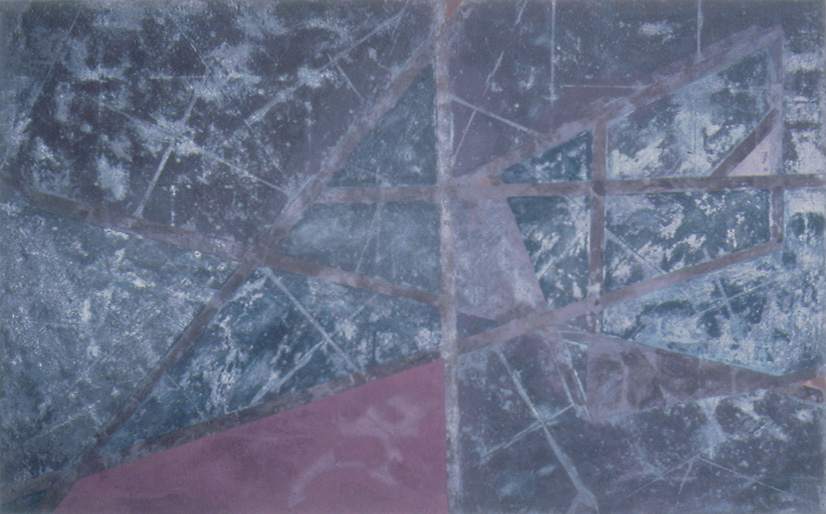
Buffalo Series, Nº 12
46" x 60"
Oil on canvas
1979
Ricardo Morín
Buffalo Series, Nº 12
46″ x 60″
Oil on canvas
1979

For those of us who have lost someone,

whose presence now rests in memory

and whose absence shapes who we are.

May this story preserve something of their enduring trace.


Julian tried to put into writing what he had dreamed.

He wondered:    could writing remain faithful to the one who watches, trembles, and longs to understand?

—

He dreamed he was offering his mother a bowl of viper’s broth.    The serpent’s head and torn fragments of its body were still writhing, as if unaware of their condition: alive, though undone. He held the bowl with both hands; it had been handed to him by an old woman seated at the far end of a wide, shallow circular pond.    The pond seemed to contain more than water—perhaps time, or memory, or fate.    Around him loomed shadows—blurred figures repeating the same ritual, or perhaps none at all.    He could not tell.

The path to his mother was arduous; the ground was slick with a substance he could not name.    The air was dense, weighted by an oppressive silence that made each step slow, burdensome.    The viper twisted in the broth, struggling to flee.   Even so, he kept the bowl steady.    He believed—in some quiet corner of himself—that if his mother drank, healing might be reached, or understanding, or peace for them both.

When he reached her, he knelt.    He spoke gently, urging her to drink while the broth was still warm.    “Hold the spoon carefully,” he whispered.    “Just small sips.”    But she turned her face away.    She would not drink.    Whether out of fear, pride, or rejection of what was offered, he did not know.    The viper shuddered, and his heart tightened in anguish.

He awoke unsettled, exhausted.    The dream still veiled his perception.    His breath was strained, shallow in the thick air of the room.    Why couldn’t he find calm?    What, exactly, kept him awake?

He wondered if it had been a premonition—a latent fear of his own decline.    Was the writhing snake a vision of his mind losing its serenity?    Were the slow gait, the unstable ground, the trembling hands a rehearsal of his own fading?    Or was it grief—that quiet interloper of the soul, forever hungry, never sated?

He only knew he had tried to help, to steady, to offer comfort that could not be received.    And in doing so, he faced not only the absence of his mother, but the shadow of his own dread—the question of who would walk beside him when his own farewell arrived.

But perhaps—he thought—there is something sacred in the attempt.    In the offering, even when refused.    In the slow advance—however uncertain it may be.


There, humility may dwell:

the kind that does not demand,

and yet disarms pain

by its presence—

too steady to be cast aside.

It meets no resistance—

only the quiet invitation to be welcomed.

Ricardo F. Morin Tortolero

Bala Cynwyd, Pa, June 2, 2025


“What the Mind Forgets but the Heart Quietly Keeps”

April 20, 2025

*

*


“Mario Vargas Llosa was a daring truth-teller.   He was also my friend.”

— Marie Arana, The Washington Post

Read the full article


*

I sent Marie Arana’s moving tribute to my sister, Bonnie, who had directed several of Vargas Llosa’s plays in Madrid and had encountered him on more than one occasion.    I knew this news would strike a deeply personal chord.

“It’s clear how deeply Vargas Llosa’s death has affected you,” I wrote to her.

“You felt close to him—not only as a reader or as a playwright, but as someone whose voice accompanied you through many chapters of your life.    Your grief resonates with me, because I understand what it means to lose a figure who, though not family, becomes part of our inner landscape—someone who shapes our ideas, our convictions, even our way of seeing the world.”

She replied:    “the death of such a brilliant mind—so present for decades—left a void that is hard to name.”    That idea moved me deeply.

“It saddens me profoundly,” I wrote back,

“to consider the silence that now follows him.    I understand why this hits you so hard—perhaps because Vargas Llosa stood for the very opposite:    a luminous intellect, fiercely articulate.   To imagine even he is gone…    it hurts.”

“I’m with you,” I added.

“And even from afar, I hold you in this grief.”

These reflections stirred memories of our own family—of our father, whose cognitive decline began after a traumatic brain injury.    He slowly lost his speech, his clarity, his grasp of the world around him.

And our mother, who held on much longer, also slipped away eventually—her presence fading in slow motion.

Our paternal and maternal uncles, Calixto and Fredy, experienced the same kind of long, quiet departure.    Years of silence.   Gradual disappearances.    Losses we didn’t always know how to name, but which marked us all.

It’s a pattern I can’t overlook.

I’ve done the research.    (You may not know this.)    Genetically, my risk for similar decline falls in a moderate range.   Not a verdict, not a guarantee—just a presence.   A shadow that walks beside me, saying nothing, revealing nothing.

Sometimes I wonder whether knowing this helps or hurts.

But I choose to know.

I choose to face it.

Because if ever I find myself on that road, I want to walk it with the same dignity I saw in our parents—even in confusion, even in silence—when their eyes could still recognize us with a flicker of tenderness.

And I want you to know that.

I want us both to remember.

*

Ricardo Federico Morín Tortolero

April 17, 2025; in transit from Florida to Pennsylvania