Posts Tagged ‘democracy’

Domains of Action

January 14, 2026

A diagnostic study of how public life continues to function when judgment is limited and conditions remain unsettled


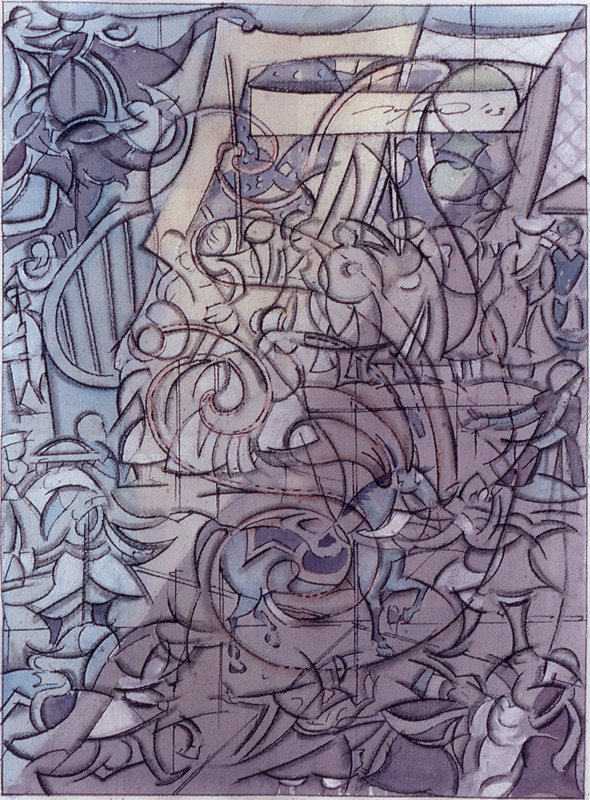
Mantra: Domains of Action
21” x 28.5”
Watercolor, graphite, wax crayons,
ink and gesso on paper 
2003

Note:

Nothing I say belongs to the painting.

The painting does not need words.

It already speaks in its own medium, to which language has no equivalent.


This work was not written to advance a position or to resolve a debate.   It emerged from sustained attention to conditions that could not be ignored without distortion.   Writing, in this sense, is not an expression of purpose, but a consequence of awareness.

The pages that follow do not claim authority through expertise or urgency.   They proceed from the recognition that judgment must often act under incomplete conditions, and that clarity, when it appears, does so gradually and without assurance.   What is offered here is not a conclusion, but a continuation: an effort to remain faithful to what can be observed when attention is sustained.

This study does not proceed from constitutional expertise, institutional authority, or professional proximity to governance.   It proceeds from observation.   Its claims arise from sustained attention to how public life continues to function under conditions in which judgment is constrained, information remains incomplete, and decisions must nonetheless be made.

In fields where credentialed knowledge often determines legitimacy, writing from outside formal authority can invite dismissal before engagement.   That risk is real.   Yet the conditions examined here are not confined to technical domains.   They are encountered daily by citizens, officials, institutions, and systems alike.   Judgment under uncertainty is not a specialized activity; it is a shared condition.

The absence of formal expertise does not exempt this work from rigor.   It requires a different discipline:   restraint in assertion, precision in description, and fidelity to what can be observed without presuming mastery.   The analysis does not claim to resolve constitutional questions or prescribe institutional remedies.   It examines how governance persists when clarity is partial, when authority operates through multiple domains, and when continuity depends less on certainty than on adjustment.

If this work holds value, it will not be because it speaks from authority, but because it attends carefully to how authority functions when no position—expert or otherwise—can claim full command of the conditions it confronts.

*


This work clarifies a confusion that appears across many political cultures:   the tendency to treat “republic” and “democracy” as interchangeable ideals rather than as distinct components of governance.   The chapters observe how political arrangements continue to operate when inherited categories no longer clarify what is taking place.

The method is observational.   Political life is described as it is experienced:   decisions made without full knowledge, terms used out of habit, and institutions that adjust internally while keeping the same outward form.   The analysis begins from the limits of judgment as a daily condition:   people must act before they fully understand the circumstances in which they act.

What follows does not argue for a model or defend a tradition.   It traces how language, institutions, and expectations diverge across different domains of action, and how public life continues to operate under conditions that do not permit full clarity.

*

Ricardo F. Morín,December 18, 2025, Oakland Park, Florida.


The Limits of Judgment in Public Life

1

Public life depends on forms of judgment that are uneven and often shaped by the pressures people face.   Individuals arrive at political questions with different experiences, different levels of knowledge, and different conditions under which they weigh what is put before them.  These differences do not prevent collective decisions, but they shape how clearly political terms and arrangements are perceived.   Everything that follows—how authority is organized, how participation is structured, and how each is described—develops within this clarity, which is limited and variable.

2

Political terms remain stable even when they are understood to different degrees.   Words such as republic and democracy have distinct meanings—one referring to an arrangement of authority, the other to a method of participation—yet are often used interchangeably.   The terms carry familiarity, even when the clarity required to keep them separate varies by circumstance.   As a result, public discussion may rely on established language without consistently matching it to the arrangements actually in effect.

3

A republic identifies an arrangement in which authority is held by public offices and exercised through institutions rather than personal rule.   A democracy identifies the method through which people participate in public decisions, whether directly or through representation.   A republic describes how authority is contained; a democracy describes how participation is organized.   Because these terms refer to different dimensions of political life—one structural, the other procedural—a single system may combine both.   The United States exemplifies this combination: authority is institutional and public, while participation is organized through elections and collective choice.

4

Public discussion often relies on familiar terms to describe political arrangements without tracing how authority and participation are actually organized.   Broad references substitute for institutional operation, allowing language to remain continuous even as circumstances shift.   The terms persist not because they precisely describe current arrangements, but because they provide a stable vocabulary through which public life can continue to be discussed as it adapts.

5

Patterns of this kind appear across many societies.   When circumstances are unstable, authority tends to concentrate; when conditions are steadier, participation often widens.   The direction is not uniform across countries or periods, but the pattern is recognizable:   authority gathers or disperses in response to conditions rather than to the language used to describe political life.   What varies is how clearly a society distinguishes between the structure that contains authority and the method through which participation occurs.

6

This movement between concentrated and dispersed authority appears differently across national contexts.   In Venezuela, references to the republic have often accompanied periods of strong executive direction, while appeals to democracy have not consistently been supported by durable procedures of participation.

In the United States, the emphasis sometimes reverses.   Democratic language is used to affirm broad popular involvement at the point of election, while republican structure is invoked to justify subsequent limits on participation through institutional filtering—nominee selection, confirmation timing, strategic vacancies, and procedural sequencing.   Presidential nominations move from popular mandate into Senate committee review, confirmation votes, and ultimately lifetime tenure, where decision-making authority is consolidated beyond direct public reach.

The terms differ, but the underlying pattern converges:   participation expands symbolically at the moment of selection and contracts structurally in the domains where authority is exercised over time.

7

Public life is easier to follow when the distinction between structure and participation remains visible.   A republic identifies how authority is arranged through offices and institutions; a democracy identifies how participation is organized through collective procedures.   When these terms are used without that distinction, attention shifts from institutional operation to nomenclature.   Debate turns toward language rather than process, and the movement of authority becomes harder to trace.

8

No single combination of structure and participation satisfies all the demands placed on public life.   Concentrated authority allows for speed but limits inclusion; broad participation expands inclusion but slows coordination.   Most governments combine these elements in varying proportions, and those proportions change as conditions change.   The relation between authority and participation becomes clearer in some periods and more opaque in others.

9

When this relation is unclear, people orient themselves by what is most visible.   Some look to executive action; others to representative bodies; many respond primarily to immediate outcomes.   These points of reference shape how the system is experienced even when its formal structure remains unchanged.

10

Public life continues not because its conditions are settled, but because decisions cannot wait for full certainty.   Authority acts while circumstances remain incomplete, and participation proceeds without full anticipation of its effects.   The system endures through this necessity: decisions are made under partial visibility, terms persist beyond their precision, and institutions adjust internally without losing their outward form.   What holds public life together is not clarity, but the need to proceed in its absence.


Executive Action Under Uncertainty

1

Executive action is the domain in which decisions are least postponable.   Unlike deliberative bodies, the executive is structured to act before conditions stabilize.   Time pressure, incomplete information, and competing signals define its operating environment.   This does not make executive judgment exceptional; it renders its limits more visible.

2

Because executive decisions are publicly observable, they often become the primary reference point through which political life is interpreted.   Orders, statements, appointments, and enforcement actions are easier to see than the processes that precede or follow them.   Visibility creates the impression of control even when outcomes remain uncertain.

3

The authority of the executive is often described as personal, yet it is exercised through institutional mechanisms.   Decisions attributed to an individual are carried out through agencies, procedures, and delegated discretion.   This layered execution allows action to proceed while responsibility is distributed across structures that remain largely out of view.

4

Periods of uncertainty tend to compress authority toward the executive.   When coordination slows elsewhere, executive action fills the gap.   This concentration does not require a change in constitutional structure; it occurs within existing forms as responsibilities narrow and timelines shorten.

5

Public judgment frequently focuses on decisiveness rather than conditions.   Speed is mistaken for clarity; repetition for resolve.   The question of whether a decision could have been otherwise is displaced by whether it was made visibly and without hesitation.

6

This focus alters how accountability is perceived.   Because executive action is immediate, it absorbs praise and blame even when outcomes depend on factors beyond executive control.   The executive domain becomes symbolically overloaded, functioning as a proxy for the system as a whole.

7

Over time, this dynamic reshapes expectations.   Executives are asked to resolve conditions that no single office can manage.   When results fall short, dissatisfaction is personalized rather than structural.   Judgment narrows toward figures instead of processes.

8

The persistence of executive action under uncertainty does not indicate failure elsewhere.   It reflects the necessity of action where delay carries its own costs.   The executive does not eliminate uncertainty; it operates within it.

9

As established in Chapter I—The Limits of Judgment in Public Life—the distinction between structure and method remains intact.   Executive authority is one structural component of the republic.   Its prominence under uncertainty does not convert the system into personal rule, nor does it dissolve other forms of participation.   It alters their relative visibility.

10

Executive action continues because decisions cannot wait for conditions to stabilize.   What the public observes is not mastery, but motion.   The domain appears decisive not because it resolves uncertainty, but because it must act while relevant information remains in flux.


1

Administrative action operates at a distance from public attention, not because it is concealed, but because it unfolds through structures designed for continuity rather than visibility.   Rules are applied, procedures adjusted, and priorities reordered within agencies whose work sustains governance without occupying the foreground of political life.   These actions rarely present themselves as discrete decisions, yet they shape outcomes as directly as legislative acts or executive orders.

2

Although the executive branch bears the most visible weight of action, it does not act alone.   Authority moves through a dense internal structure—departments, offices, and administrative hierarchies—that translates executive direction into practice.   Within this structure, different temporal orientations coexist.   Some units respond to the immediacy of political mandates; others operate within constitutional and statutory frameworks intended to secure duration, stability, and institutional memory.

3

What appears publicly as a unitary executive act is, in practice, the visible edge of a distributed process.   Administrative authorities do not replace the legislative function, nor do they interpret law in the judicial sense.   They apply existing statutes, regulations, and precedents to concrete circumstances, exercising discretion only within bounds already defined.   Governance continues through this application not because interpretation expands, but because execution must proceed even when direct legislative action is absent or delayed.

4

Procedural substitution occurs when formal decision-making cannot advance at the same pace as events.   When legislation stalls, or when executive authority reaches its constitutional limits, administrative processes absorb responsibility by adjusting how existing rules are applied.   Guidance is refined, enforcement priorities are reordered, and procedural pathways are recalibrated so that action can continue without altering the legal framework itself.

5

The effect of this adjustment is cumulative rather than declarative.   Procedures acquire force through sustained use across cases, offices, and time.   What matters is not the announcement of a decision, but the establishment of a practice that becomes operative through repetition.   Authority is exercised through continuity of application, not through proclamation or display.

6

Because responsibility is distributed across agencies and routines, public judgment often struggles to locate where change occurs.   Outcomes appear without a single moment of decision to which they can be traced.   This dispersal does not eliminate accountability, but it complicates it. Effects are experienced before their procedural origins are understood, if they are understood at all.

7

Over time, this mode of governance reshapes public expectations.   Citizens may sense that conditions have shifted while remaining uncertain about who acted or how.   Dissatisfaction attaches to the system as a whole rather than to identifiable actors, not because authority is absent, but because it operates through channels that do not align with public narratives of decision and responsibility.

8

Administrative displacement does not signal institutional breakdown.   It reflects the necessity of maintaining governance under constraint.   When formal decisions cannot be taken at the speed required, procedures adapt so that authority continues to function without exceeding its legal bounds.   The system does not suspend itself; it adjusts its pathways.

9

This domain illustrates the separation between form and operation established in the opening chapter.   The constitutional structure of authority remains intact, while its execution shifts in emphasis and sequence.   What changes is not who holds power, but how that power is carried forward under conditions that do not permit explicit resolution.

10

Governance persists through these substitutions because action cannot stop.   Authority moves not by abandoning its limits, but by working within them.   The continuity of public life depends less on visible decisions than on the capacity of institutions to apply existing frameworks to changing circumstances—imperfectly, and without claiming finality.


Electoral Ritual and the Persistence of Form

1

Elections are the most recognizable feature of democratic participation.   They provide a recurring structure through which public involvement is organized and displayed.   Their regularity creates a sense of continuity even as surrounding conditions change.

2

As ritual, elections affirm participation through repetition.   Procedures remain familiar—campaigns, voting, certification, transition—and establish a shared sequence that signals order and legitimacy.   These outward forms sustain confidence in the process, even when outcomes remain uncertain.

3

Elections endure not because they resolve conflict, but because they organize trust at the point of selection.   They do not settle disagreement; they make continued coordination possible by establishing a recognized moment of authorization.

4

Once trust is organized at the point of selection, public attention shifts from the mechanics of participation to the visibility of results.   Winning and losing replace examination of how participation translates into policy, administration, or enforcement.   The ritual satisfies the expectation of involvement, while attention moves away from the pathways through which authority is exercised after selection.

5

This emphasis on outcome reinforces symbolic stability.   As long as elections occur on schedule and results are recognized, the system appears intact.   Questions about how decisions are made afterward—how authority is carried forward, distributed, and constrained—receive less sustained attention.

6

Discrepancies between electoral choice and lived experience are often attributed to individuals rather than to institutional pathways.   Dissatisfaction becomes personalized, while the structural distance between participation and governance remains largely unexamined.

7

Electoral rituals persist because they serve a stabilizing function.   They mark transitions, renew legitimacy, and provide a shared reference point for public life.   Their endurance does not depend on their capacity to resolve underlying pressures, but on their ability to preserve coordination in the presence of disagreement.

8

As conditions change, participation may become more expressive than effective.   Voting signals presence and alignment, even when it does not materially alter administrative or executive trajectories.   Expression remains visible; influence becomes less certain.

9

Democracy, understood as method, remains visible and active.   What fluctuates is the degree to which participation reaches into the domains where decisions are continuously adjusted, and where authority continues to operate after the moment of voting.

10

Public life continues through this arrangement because action cannot pause at the point of selection.   Decisions proceed while conditions evolve, information accumulates unevenly, and responsibility shifts across domains.   What endures is not resolution, but continuity: governance advances through adjustment rather than completion, sustained by institutions that act without claiming finality.
“The Rhetoric of Threat”

December 1, 2025

*

Ricardo Morín
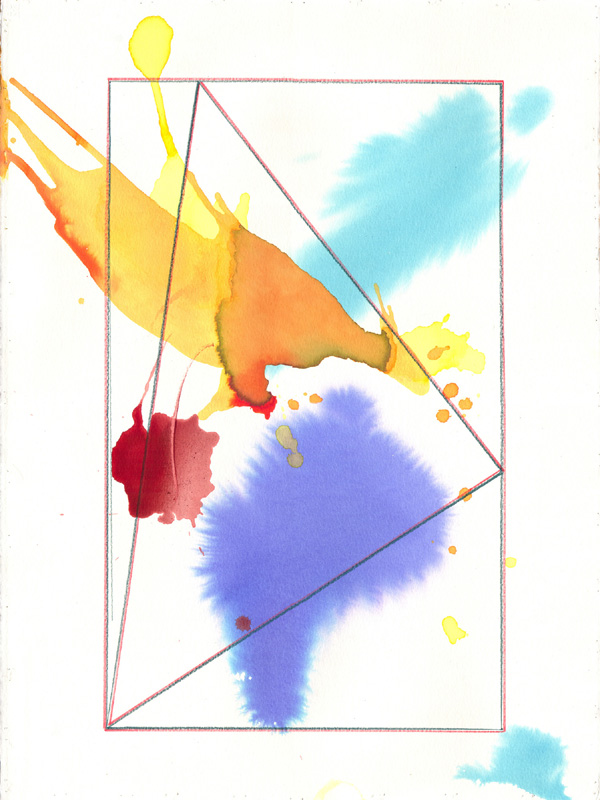
Triangulación 9: The Rhetoric of Threat
56 x 76 cm
Watercolor and wax crayon on paper
2007

Ricardo Morín

November 2025

Oakland Park, Florida

Authoritarian language does not arise as excess or accident; it emerges as a deliberate strategy designed to reorganize public perception until difference appears suspect and complexity becomes intolerable.   Within this framework, the phrase attributed to the Argentine president Javier Milei—“if an immigrant does not adapt to your culture, then it is not immigration but an invasion” (or https://youtube.com/shorts/EJ9RRC3pyTQ?si=xehJCUD8fIIpaqsw )—functions as a mechanism of extreme reduction.   It replaces the historical reality of migration with a binary schema meant to provoke alarm.  The leader is not describing a fact; he is manufacturing an enemy.

This formulation shifts the migratory experience into a warlike imaginary in which any form of difference is construed as aggression.   Culture—treated as a static and homogeneous block—is framed as a besieged territory requiring defense, and plurality as a threat that can only be resolved through submission.   Under this logic, the migrant ceases to be a person and becomes an abstraction crafted to justify coercive impulse.

The paradox is unmistakable:   what is proclaimed as the defense of identity is, in truth, an effort to standardize it; what is presented as caution operates as an instrument of fear.  Rather than analyze, the language disciplines.   And in doing so, it exposes its deeper function:     it shapes an emotional climate ready to accept measures that, under any other light, would be incompatible with democratic life.

This is the dimension that most clearly reveals the nature of the statement:   it is not a commentary on immigration but a mechanism of affective control.   By turning coexistence into compulsory assimilation, it introduces a dehumanized conception of the social world, one in which diversity ceases to be constitutive and becomes an obstacle to be neutralized.   Ultimately, this discourse seeks not to understand reality but to govern it.


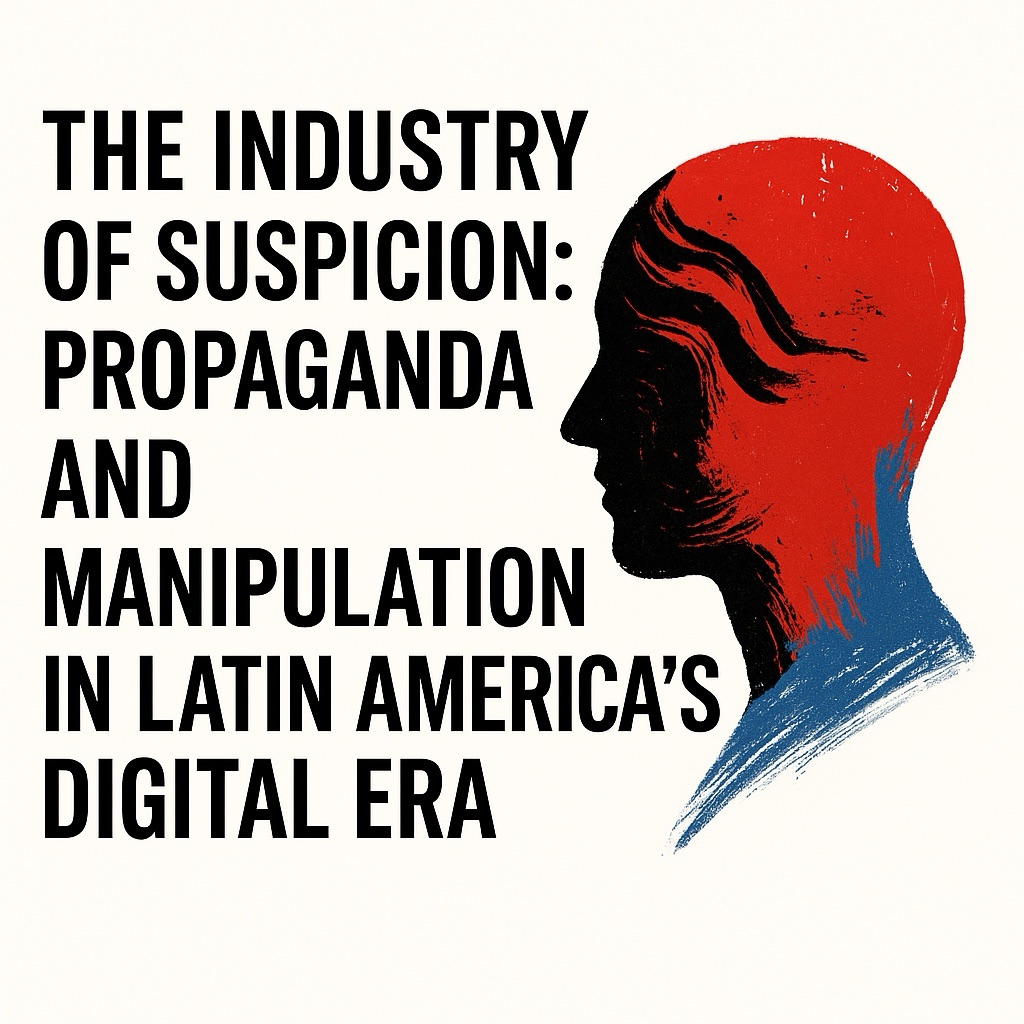
“The Industry of Suspicion: Propaganda and Manipulation of the Digital Era in Latin America”

October 15, 2025


By Ricardo F. Morín

Oct. 14, 2025

In the post-truth landscape of Latin American media, where outrage has become currency, few figures illustrate the fusion of ideology and marketing as clearly as Inna Afinogenova.    She has become the most recognizable voice of authoritarian suspicion in the Spanish-speaking sphere.    From platforms such as Canal Red Latinoamérica, her discourse forms part of a vast network of disinformation spreading across the region, cloaked in the rhetoric of critical thinking and popular emancipation.    These networks—spanning Moscow, Tehran, Beijing, and several Latin American governments—follow a single script: to dismantle trust in liberal democracy, to weaken institutions, and to turn permanent doubt into a substitute for conscience.    In the name of informational sovereignty, they replace debate with discredit, analysis with suspicion, and truth with narrative.    Their power lies not in blatant falsehoods but in the emotional manipulation that transforms confusion into conviction.    Within this context, Afinogenova stands not as an isolated commentator but as the emblem of a sophisticated propaganda apparatus—one that disguises obedience to twenty-first-century autocracies beneath the costume of dissent.

Inna Afinogenova, born in Dagestan in 1989, is a Russian journalist who worked as deputy director of RT en Español until May 2022.    She resigned citing her disagreement with the war in Ukraine and the imposition of a state-sanctioned narrative of aggression.    Since then, she has collaborated with geopolitical and Latin American media such as La Base, produced by the Spanish newspaper Público, and participates in Canal Red, an audiovisual project led by Pablo Iglesias (former vice-president of Spain and founder of the left-wing party Podemos, now active in political media).    There she directs and hosts programs like CaféInna and contributes to political analysis, particularly on Latin America.    Her audience is broad and her reach on digital platforms considerable, which makes her an influential figure in the political and informational debates of the Spanish-speaking world.

Her trajectory, however, has not escaped controversy.    During her tenure at RT en Español, she was one of the network’s most visible faces in Latin America, amplifying narratives that portrayed Western powers as inherently deceitful and predatory.    An opinion column in The Washington Post described her as “the Spanish voice of Russian propaganda,” citing her recurring defense of positions favorable to the Kremlin.    In December 2021, two months before the invasion of Ukraine, she used her program Ahí les va to mock Western intelligence warnings of an imminent attack and predicted that “January will come, then February, and still no invasion,” implying that the media hysteria served the interests of NATO.    Such episodes, though later overtaken by events, exemplify her rhetorical method:    to transform skepticism into disbelief and disbelief into persuasion.

Following her departure from RT, Afinogenova has continued to operate in media circles ideologically aligned with the Latin American left, reinforcing a discourse that equates the Western press with manipulation and imperialism.    Outlets such as Expediente Público have noted her role in shaping narratives within partisan campaigns, often echoing state-sponsored or geopolitically motivated lines from Russia, China, or Iran.    Through Canal Red and Diario Red, both associated with Pablo Iglesias, she participates in content ecosystems that frequently recycle material from international broadcasters like CGTN.    In countries such as Honduras, she has been accused of contributing to media strategies that favor left-wing candidates under the guise of “sovereign communication.”   While the evidence does not show a direct chain of command linking her to a specific regime, the pattern of thematic consistency reveals a coherent ideological alignment rather than independent journalism.

This alignment has provoked renewed debate since the release of her recent video, “¿Premio Nobel de la Paz… o de la Guerra?”, where she presents the Nobel Peace Prize awarded to María Corina Machado as a maneuver of geopolitical design rather than a moral recognition.    The video does not examine facts so much as it interprets intentions, suggesting that the award serves Western influence instead of honoring civic courage.   The argument, though rhetorically effective, confuses correlation with causality.    It is possible to acknowledge the imperfections of international institutions without denying the ethical weight of public bravery.   The Nobel Prize, like every human institution, reflects judgments; but in this case, it distinguishes a life of civic risk undertaken without weapons, privileges, or access to the coercive power of the State.

Questioning motives is legitimate; insinuating conspiracies without evidence is not.   Every critical voice bears responsibility, for truth demands proportion, not projection.   The struggle of María Corina Machado cannot be reduced to the rhetoric of “Western intervention” or dismissed as “fabricated dissent.”   It belongs to the conscience of a people seeking self-determination through legitimate means after decades of dispossession.    Respecting pluralism requires granting others the same intellectual good faith one demands for oneself.   Debate ennobles democracy only when grounded in verifiable facts and moral clarity, not when suspicion itself becomes the argument.    Between necessary skepticism and systematic suspicion lies a moral frontier:    crossing it is to pass from thinking freely to serving without knowing it.


“María Corina Machado: The Inheritance of a Republic”

October 14, 2025


By Ricardo Morín

Oct. 14, 2025

There are lives that seem to recapitulate the destiny of a nation, as if history, in search of renewal, gathers its scattered promises into one mortal form.  María Corina Machado stands within that rare order of beings in whom blood, memory, and conviction converge—not as privilege, but as burden.  She was not merely born into Venezuela’s republican lineage; she was summoned by it.  The call that first thundered through the assembly halls of Caracas in 1811—when its independence was declared and its first republican constitution conceived—still vibrates beneath her name.

Her ancestry reaches into the first pulse of the Republic.  From the Rodríguez del Toros, who set their signatures beneath the Act of Independence, to the Zuloaga engineers who electrified a nation, hers is a genealogy woven into the civic arteries of Venezuela.  It is a lineage that chose service over title, innovation over indulgence, and fidelity to the law over the ease of silence.  In that tradition, the notion of freedom is not an abstraction—it is inheritance, obligation, and vocation.  It is the thread that binds a people to their conscience.

When the institutions that once defined Venezuela began to crumble, when legality became theater and words lost their weight, Machado stepped into the void with the gravity of someone aware that retreat was impossible.  Her defiance was not theatrical—it was ancestral.  Every gesture, every refusal to submit, bore the quiet authority of history fulfilled.  She spoke as one who understood that to preserve dignity in times of humiliation is the purest form of resistance.  There is, in her manner of being, that rare synthesis of intellect and steadfastness that defines the moral personality of a nation at its best—lucid, unbending, and human.

Yet today, her adversary is not one but many.  Before her stands not only a narco-state that has hollowed out Venezuela’s sovereignty, but a fractured opposition—an archipelago of parties and personalities bound less by principle than by convenience.  Factionalized, transient, and transactional, these groups have transformed plurality into pretext and compromise into commerce.  Many have learned to live off the dictatorship they denounce.  They negotiate freedoms for themselves even as the country sinks deeper into captivity.  Against that duplicity, Machado’s presence has become a moral indictment: her clarity exposes their corruption; her endurance, their opportunism.

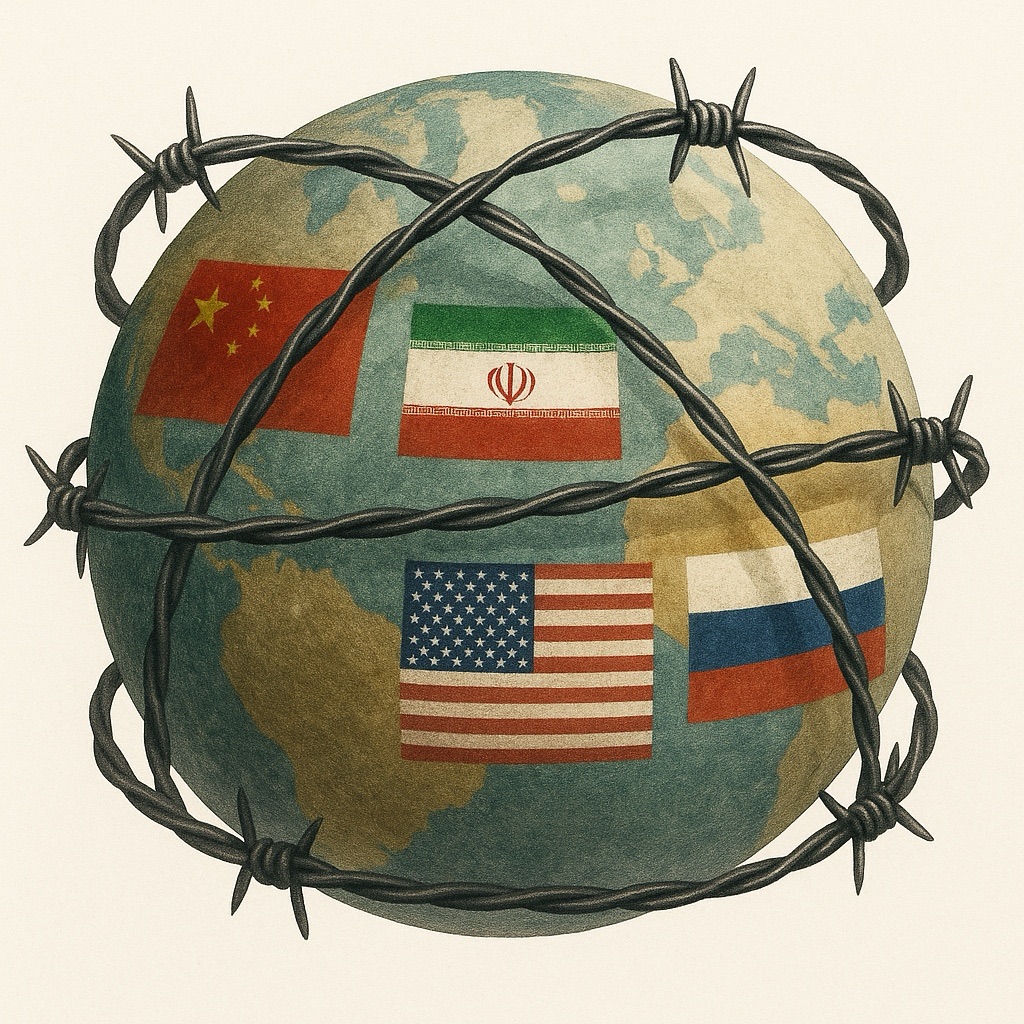
Around this internal disarray, the world circles in watchful appetite.  Venezuela’s vast natural wealth—its oil, gas, gold, and rare minerals—has become the prize of criminal networks and multinational investors alike.  Russia, China, Iran, and the United States, each cloaked in rhetoric of salvation, compete not to free the country but to secure a share of its exhaustion.  Behind the diplomatic masks of assistance lies the same calculation: that chaos can be profitable, that a nation weakened by hunger and fear can be managed more easily than one restored to its sovereignty.  This, for twenty-five years, has been Venezuela’s condition—a field of material, moral, and human extraction; its people scattered, its institutions despoiled, its memory pawned to the highest bidder.

In such a landscape, María Corina Machado stands as both witness and counterpoint.  Her struggle has never been for power but for coherence—for the recovery of a civic language capable of naming what has been lost.  To speak of law, truth, and justice amid pervasive corruption is to resurrect meaning itself.  Her voice has become the thread that gathers the nation’s scattered conscience, reminding Venezuelans that dignity cannot be negotiated, and that no foreign savior will restore what only citizens can redeem.

To see her walk through the streets, welcomed not by luxury but by faith, is to glimpse a country remembering itself.  She has become, willingly or not, the mirror through which Venezuelans rediscover their own moral architecture: decency, courage, compassion, and an unextinguished appetite for truth.  In her endurance, the long-interrupted dialogue between people and Republic resumes.

The Nobel Peace Prize, bestowed upon her, is therefore not a coronation but a recognition—an acknowledgment that her struggle transcends the moment and becomes emblematic of the human spirit’s refusal to yield to despair.  In awarding her, the world affirms that Venezuela’s republican dream—born in fire, preserved in conscience—still breathes through one of its daughters.  It is the dream of a nation that believes peace must be built not upon submission, but upon moral clarity; not upon silence, but upon the unwavering voice of the citizen.

What María Corina Machado represents is more than opposition to tyranny.  She is the embodiment of continuity—of the idea that a Republic, like a soul, survives so long as there remains one person willing to bear its weight with dignity.  Her ascent is not accidental—it is the return of an ancient promise.  In her composure, Venezuela recognizes itself once more: wounded yet unbroken, luminous in defiance, faithful to the destiny inscribed in its first act of freedom.


“The Veil of Liberation: Venezuela and the Machinery of Power”

October 10, 2025


Ricardo F. Morín — Oct. 10, 2025

Although the awarding of the Nobel Peace Prize (2025) to María Corina Machado brings joy and honor to those who still believe in the possibility of a democratic Venezuela, it also reveals a far more complex reality; one that demands reflection.

The international press has yet to grasp the dream surrounding the supposed liberation of Venezuela from a narco-state.     Venezuelans continue to wait indefinitely for liberation.    Beneath this hope lies a deeper bondage: the nation’s territory continues to be bound to multinational interests (Chinese, Russian, American, and others) driven not by ideology but by competition between investors and criminal networks.    For all of them, a prolonged conflict in Venezuela is convenient; it serves as a bridge to a regional metamorphosis and justifies the expropriation of the natural resources of the country; it aims at consolidating hemispheric dominance by the multinational interests.     The situation in Venezuela is therefore not only political but also structural; it is an experiment in which sovereignty is traded for access and resistance itself becomes a form of captivity.

The crisis in Venezuela reveals a moral conflict in modern politics:    how suffering can both be exploited and perpetuated when comprehension yields to fantasy.   The dream of liberation has become one of the nation’s most persistent fantasies.   Behind the language of emancipation lies a silent convergence of global interests; each one sustains the very conflict it claims to oppose.   In Venezuela, disorder legitimizes intervention and chaos provides the pretext for extraction.   In this sense, Venezuela is not merely a nation in distress but also a stage upon which the grammar of domination continues to be enacted through the vocabulary of deliverance

The challenge is no longer to imagine freedom as an external rescue but to comprehend how dependence disguises itself as salvation.  Only comprehension (the act of seeing beyond grievance and beyond consolation) can pierce the veil of liberation and restore meaning to the very idea of freedom.


Editor: Billy Bussell Thompson

“The Myth of Rupture:

September 30, 2025

Continuity as the Enabling Condition of Change”


Ricardo F. Morín
Untitled #6
Watercolor
2003

By Ricardo Morin

September 30, 2025

Bala Cynwyd, Pa

Nothing human begins from nothing.   Institutions, languages, belief systems, and works of art all arise from what preceded them.   Creation is not the rejection of inheritance but the transformation of it.   Every act of making draws upon accumulated perception, memory, and experience.   This insight is crucial to understanding contemporary culture, where claims of unprecedented change often conceal deep continuities beneath the surface of novelty.   Human beings, bound by temporality, cannot detach themselves from what has been; they can only reorder and reinterpret the materials already available to them.

The notion of invention is often described as a break with the past, a leap into the unknown.   Yet even the most radical departures are shaped by what came before.   The ideals of modern democracy, for example, did not emerge spontaneously.   They were built upon classical Greek ideas of citizenship as a shared civic responsibility, rooted in isonomia—equality before the law—and in the belief that legitimate authority derives from the deliberation and participation of free citizens.   They also drew deeply on Roman conceptions of law as a universal and rational order capable of binding diverse peoples into a common political framework, and on the Roman principle of res publica, which conceived the State as a public entity oriented toward the common good rather than the will of a single ruler.   These foundational ideas, adapted and reinterpreted over centuries, provided the intellectual architecture on which modern democratic institutions were constructed.   Perception frames invention.   It provides the vocabulary, assumptions, and conceptual tools that make new ideas possible.   What seems entirely new still carries the imprint of what it sought to move beyond.   On closer examination, the products of creativity are not isolated acts of originality but reconfigurations of existing structures.   Evolution, rather than spontaneous emergence, governs how ideas, institutions, and cultures take shape.

Memory underlies this process.   It is not a passive record of events but an active medium through which possibilities are conceived and action becomes intelligible.   Imagination draws its material from memory; it combines and redirects memory toward conditions not yet realized.   This is nowhere more evident than in the idea of freedom, a concept that resists simple definition yet has long carried two complementary meanings.   The first, articulated most clearly in the classical Greek tradition, understands freedom as eleutheria—the condition of living without domination or external constraint, a state in which individuals are not subject to arbitrary power.   The second, rooted in the Roman legal and civic tradition, conceives freedom as libertas—the capacity to participate actively in the governance of a political community and to shape its laws and institutions.   Both meanings reveal how deeply freedom depends on historical precedent:   it requires language to articulate its claims, institutions to guarantee its exercise, and collective memory to frame its significance.   Far from existing apart from what has been, freedom is shaped and enabled by what has already been conceived, argued, and enacted.   Prior experience supplies the references and alternatives against which choices acquire meaning.   Without that reservoir of knowledge, novelty would lack coherence and direction, and the exercise of freedom would collapse into arbitrary impulse.   Human beings do not invent in a void; they work within the continuity of time and adapt what has been lived and learned into forms suited to what is yet to come.

This same dynamic defines the formation of identity.   Selfhood is not an isolated act of invention but a continuous negotiation with what has been received.   The very idea of the self has itself evolved through history:   in classical philosophy, it was often conceived as a psyche—an inner essence shaped by reason and virtue and embedded within a larger cosmic order.   Christian thought reinterpreted this understanding through the notion of the soul as a unique bearer of moral responsibility, oriented toward salvation and defined by its relationship to God.   Early modern thinkers such as John Locke then transformed this inheritance by grounding personal identity in memory and consciousness — a conception that would later inform modern ideas of individual autonomy.   Even the impulse to define oneself against the past relies on categories inherited from it.   Identity is therefore neither static nor wholly self-created; it is a process of reinterpretation through which the individual positions what is given in relation to what is chosen.   Human beings exist in the tension between inheritance and aspiration, between the weight of memory and the desire for renewal.   That tension is not an obstacle to authenticity but its condition, for without the framework provided by the past there would be nothing from which to depart.   Continuity and change are not opposing forces.   Without continuity, there is no ground on which to become.   Without change, continuity hardens into mere repetition.   The act of becoming depends on the dynamic between the two.

Viewed from this perspective, the human condition is defined less by pure invention than by the capacity to transform.   What is called “new” is the familiar reorganized with new intentions, the established redirected toward new purposes.   Recognizing this does not diminish creativity.   It clarifies its nature.   Humanity’s most significant achievements—in politics, art, science, and thought—are not escapes from what has been.   They are deliberate reinterpretations of what has been, shaped to answer new questions and confront new circumstances.   In the sciences, paradigmatic shifts often described as revolutions still follow this pattern.   Einstein’s theory of relativity did not erase Newtonian mechanics; it incorporated and extended its principles, a revision that revealed their limits while preserving their usefulness within a broader understanding of space, time, and motion.   This same principle governs artistic innovation.   The Renaissance revival of classical forms did not merely reproduce antiquity; it reinterpreted ancient visual languages to express the spiritual and humanistic concerns of a new era.   The evolution of digital communication and artificial intelligence reflects a comparable continuity.   The internet did not replace human interaction; it expanded its reach and scale, a transformation that altered how language circulates, how memory is archived, and how collective knowledge is formed.   Similarly, artificial intelligence—often portrayed as autonomous or unprecedented—rests on centuries of linguistic, mathematical, and conceptual developments.   These systems extend rather than supersede the cognitive inheritance from which they originate.   The future is built in this way:   not in its rejection of the past but in its continuous interaction with it.

Resistance to this understanding persists wherever the idea of evolution is denied.   Such resistance is rarely a matter of evidence alone.   It reflects a desire for permanence—for a beginning that is untouched by change and a truth that stands apart from time.   It offers certainty where process allows none and promises stability in place of adaptation.   Yet even this resistance is shaped by the forces it seeks to escape.   Languages evolve, beliefs adjust, and traditions adapt, even as they proclaim their immutability.   Those who defend what is fixed do so with concepts and arguments that themselves have been shaped by historical change.   The very doctrines that claim timeless authority — such as the medieval conception of divine sovereignty, once invoked to legitimize monarchies and later transformed into the principle of popular sovereignty in modern constitutional systems—reveal this dependence:   they persist not by remaining unchanged but by being continually reinterpreted to meet new contexts.   The contrast, therefore, is not between evolution and its absence, but between recognition and refusal.   The reality remains:   existence unfolds through transformation, and humanity, whether consciously or not, participates in that unfolding—a truth with profound implications for how societies remember their past, shape their present, and imagine their future.


Further Reading:

  • Arendt, Hannah: Between Past and Future: Eight Exercises in Political Thought. New York: Viking Press, 1961.
  • Kuhn, Thomas S.: The Structure of Scientific Revolutions. Chicago: University of Chicago Press, 1962.
  • MacIntyre, Alasdair: After Virtue: A Study in Moral Theory. Notre Dame, IN: University of Notre Dame Press, 1981.
  • Floridi, Luciano: The Philosophy of Information. Oxford: Oxford University Press, 2011.
  • Koselleck, Reinhart: Futures Past: On the Semantics of Historical Time. Translated by Keith Tribe. New York: Columbia University Press, 2004.

“The Constitution Within”

August 10, 2025

*

Ricardo Morin
The Constitution Within
GCI
2025

*

Politics (from the Greek politikós, “of, by, or relating to citizens”) is the practice and theory of influencing people at the civic or individual level.

*

By Ricardo Morin

August 10, 2025.

~

From their earliest formulations, constitutional frameworks have been more than foundational legal agreements; they have stood as declarations of political philosophy, and defined how power should be organized, how it should be restrained, and to whom it must be answerable. Contemporary governance, to a large extent, continues those experiments, shaped over centuries of trial and adaptation. Yet these forms can endure in appearance while being emptied of substance. In more than a few States today, constitutions proclaim liberty while they narrow its scope, define rights in ways that exclude, and preserve the interests of a governing elite. Partisanship exploits the perceived limitations and vulnerabilities of others as grounds for exclusion; self-righteousness becomes a tool for domination, silences opposition, and suppresses dissent. The worth of a constitutional framework, therefore, is measured not only by its letter but by the ethical integrity of those who sustain it. Without ethics, politics loses its meaning; without civic virtue, the law ceases to serve peace and becomes an instrument of dominion.

The separation of powers, vigorously defended by Montesquieu, rests on the conviction that liberty survives when power is compelled to check power. This principle is distorted when institutions are subordinated to partisan or personal interests. In recent years, several States have formally preserved an independent judiciary while, in practice, subjected it to appointment processes controlled by the Executive or the ruling party. Such hollowing-out is not merely a technical failure; it reflects a political culture in which ambition, fear, or indifference among citizens permits the disfigurement of the very mechanisms designed to protect them. It also reveals how institutional strength and civic responsibility are bound together in ways that cannot be separated.

Historical constitutions continue to shape how political communities imagine authority. They bequeath principles that, at their best, offer adaptable frameworks for meeting new challenges without renouncing their essential core: that the legitimacy of a Government rests not on the strength of its rulers but on the solidity of the structures that limit them.

Yet these structures endure only when citizens reject duplicity and sectarianism. Divisions of ideology must not harden into exclusive loyalty to one’s own group at the expense of a shared civic framework. They endure only when citizens resist the idolatry of power, because authority loses its legitimacy once it is treated as sacred or unquestionable. And they endure only when citizens repudiate the cult of personality, in which a leader is raised above criticism through image-making, propaganda, and personal loyalty.

The durability of constitutional order, then, does not lie solely in written texts or institutional arrangements. It rests equally on the civic ethic of those who inhabit them. When ambition, fear, or indifference allow citizens to tolerate duplicity or surrender to sectarian loyalty, the limits on power become fragile. Conversely, when vigilance and responsibility prevail, constitutions retain their strength as both shield and compass—guarding against arbitrary rule while orienting political life toward justice and restraint.

True reform is not solely institutional but also internal: a revolution in the individual and collective sphere, in which each person accepts the responsibility to act with integrity, openness, and commitment to the common good, in harmony with oneself and with others. Only through the alignment of institutional structures with civic responsibility can any Constitution preserve its meaning and endure as a safeguard against arbitrary power.

*


Annotated Bibliography

~

  • Ginsburg, Tom, and Aziz Z. Huq.; How to Save a Constitutional Democracy. Chicago: University of Chicago Press, 2019. (Ginsburg and Aziz examine the legal and institutional pathways through which democracies weaken, from court-packing to the erosion of independent oversight. They draw on comparative examples from the United States, Hungary, and elsewhere to show how constitutional mechanisms can be used to consolidate power while preserving a façade of legality.)
  • Landau, David: “Abusive Constitutionalism.” UC Davis Law Review 47 (1), 2013: 189–260. (Landau develops the concept of “abusive constitutionalism” to describe how incumbents exploit constitutional change to entrench their rule. Uses Latin American and other global cases to illustrate how amendments and reinterpretations weaken checks and balances, alter electoral systems, and undermine judicial independence.)
  • Levitsky, Steven, and Way, Lucan A.: Competitive Authoritarianism: Hybrid Regimes after the Cold War. Cambridge: Cambridge University Press, 2010. (Levitsky and Way analyze regimes that preserve the formal institutions of democracy but manipulate them to ensure ruling-party dominance. They introduce the concept of “competitive authoritarianism” as a framework for understanding how constitutional norms are hollowed out while democratic forms are maintained.)
  • Levitsky, Steven, and Ziblatt, Daniel: How Democracies Die. New York: Crown, 2018. (Levitsky and Ziblatt argue that modern democracies often decline through the gradual decline of norms rather than coups. The book shows how leaders exploit constitutional ambiguities, stack courts, and weaponize law to suppress opposition, eroding both civic trust and institutional integrity.)

~


“The New Face of Old Tyranny: …

August 1, 2025

*

… The Persistence of Francoist Nostalgia and the Discomfort Beneath It”


Ricardo Morin
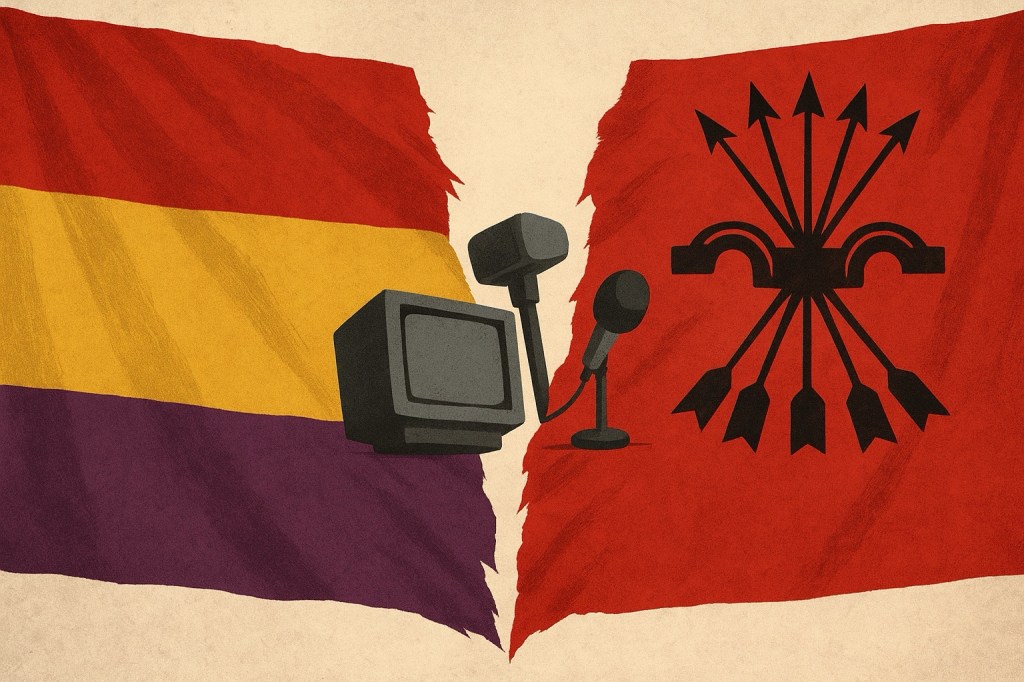
Half Republican, Half Falangist
CGI
2005

By Ricardo Morin

August 1, 2025

One cannot assess the Spanish political climate without acknowledging the rise of VOX, a far-right party founded in 2013 by former members of the conservative Partido Popular. Since 2018, VOX has gained traction by opposing regional autonomy, feminist legislation, and immigration, while defending a nationalist agenda that includes the revision—or outright rejection—of Spain’s historical reckoning with Francoism.

It is the symptom of a deeper democratic disillusionment. What resurfaces is not spontaneous historical memory, but a political and cultural framework that reasserts itself when the social agreements binding the present begin to fray. VOX’s references to the Franco regime are rarely doctrinaire or explicit, but they are unmistakable in the party’s rejection of the Democratic Memory Law, its exaltation of national unity as a sacred and untouchable principle, its condemnation of the autonomous state model, and its appeal to a so-called “natural order” that treats hierarchy, the traditional family, and social inequality as if they were objective facts of history.

What is most concerning is not that voices like these exist—they always have—but that they have regained institutional power and cultural legitimacy. Dissatisfaction with the political system, fatigue with ineffective parliamentary politics, and a growing sense of identity displacement feed into a shared national unease. This unease can be felt across a wide spectrum: small business owners who perceive the state as hostile, or young people who find no meaning in a hollow, bureaucratized political language. The grievances vary, but the far right offers a single channel: the emotional simplification of conflict—transforming fear into obedience, and uncertainty into wounded pride.

Within this framework, VOX presents itself as the only political actor with a unified narrative. Its strength does not lie in public policy, but in assertion. It offers no coherent platform of governance, but instead proposes a reactive, exclusionary identity. And here the progressive response often falters. While the institutional left—represented by the PSOE and remnants of Unidas Podemos—relies on rhetorical frames worn down by official discourse, segments of the academic and cultural intelligentsia (particularly university-affiliated think tanks and subsidized editorial circuits) have retreated into a ritualized defense of democracy, without reassessing its principles or renewing the language through which it is explained. Repeating just causes through exhausted formulas turns even the noblest ideas into noise.

Worse still, in the name of pluralism—or out of fear of being labeled sectarian—certain cultural institutions (El País, publishing houses like Taurus, or high-profile forums such as the Círculo de Bellas Artes) have offered platforms to reactionary voices under the pretext of open debate. In doing so, they have helped normalize a discourse that steadily unravels the ethical agreements underpinning democratic life. What is framed as tolerance may, in fact, be a form of structural surrender.

Spain’s history is burdened with wounds that were never fully closed. The political pacts of the Transition, born of necessity, opted for shared silence as the price of institutional stability. That silence allowed for peace, but left the past unresolved. Today, as new efforts—like the Democratic Memory Law—begin to reshape that narrative, fear returns: fear that to acknowledge historical violence might destabilize the present. VOX exploits this fear not with policy, but with symbolic refuge—offering a home to a version of Spain that feels lost.

The responsibility of the intellectual class is not to reassert inherited certainties or rehearse moral slogans. It is to sustain complexity: to resist the lure of simplification, to acknowledge the fatigue of progressive frameworks without falling into cynicism, and to offer new ways of thinking that preserve both rigor and empathy. Because while reactionary discourse gains ground through simplification, critical thought must hold its ground in nuance—even if nuance isn’t viral, even if it doesn’t win applause.

*


Annotated Bibliography

Preston, Paul: The Spanish Holocaust: Inquisition and Extermination in Twentieth-Century Spain. New York: W.W. Norton, 2012. (A comprehensive history of political and ideological violence during and after the Spanish Civil War, this work provides essential background for understanding the roots and continued appeal of Francoist narratives in Spain.)

Snyder, Timothy: On Tyranny: Twenty Lessons from the Twentieth Century. New York: Tim Duggan Books, 2017. (This compact, cautionary text distills key lessons from the collapse of democracies in 20th-century Europe and offers reflections that resonate strongly with contemporary authoritarian rhetoric.)

Stanley, Jason: How Fascism Works: The Politics of Us and Them. New York: Random House, 2018. (An incisive study of fascist techniques and psychological mechanisms, this book helps explain how divisive identity politics and historical denial function in modern ultranationalist movements.)

*


“Censorship, Caligula, and the Return of Imperial Propaganda”

July 31, 2025

*


Ricardo Morin
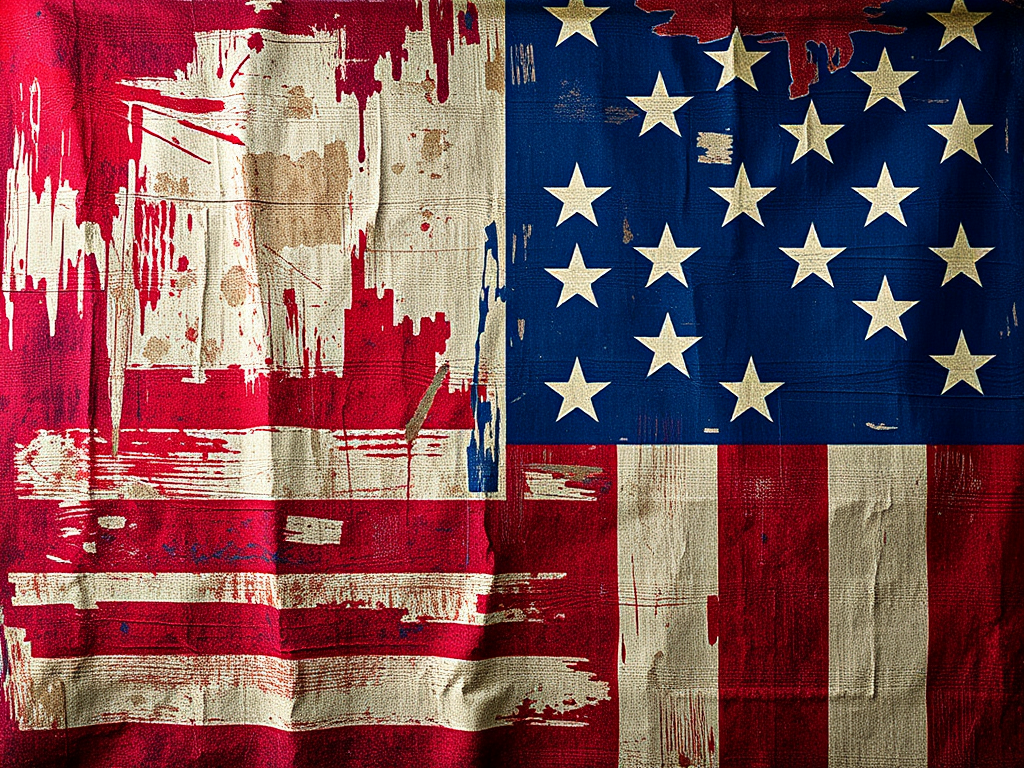
A Flag in Distress
CGI
2025


Ricardo F. Morin

July 31, 2025

*

Brendan Carr, whom Donald Trump designated Chairman of the Federal Communications Commission (FCC), recently defended the use of regulatory authority to induce a “course correction” within the media.  This intervention marks a disturbing turn in the use of public institutions to advance a politics of grievance.  Justified as an effort to combat diversity, equity, and inclusion (DEI) initiatives, portrayed as forms of discrimination contrary to the public interest, this position reveals a broader ideological purge directed not toward restoring any genuine neutrality but toward eliminating pluralism itself.

This form of censorship, presented as a defense against “ideological indoctrination,” constitutes an explicit repudiation of fundamental democratic commitments, particularly the principle of freedom of speech.  Equity does not threaten democratic cohesion.  The danger lies in the repressive apparatus now being consolidated to discredit its purposes and silence its defenders.  This strategy follows not a normative but a theatrical logic:  it is a spectacle of power, not a legitimate exercise of government.

In this respect, the comparison with Caligula’s reign is revealing.  The Roman emperor turned politics into a theater of personal rule, in which caprice displaced law and punishment was staged as a demonstration of dominion.  His purpose was not merely to govern but to subjugate: reducing law to mere scenery for his will.  Under Trump, institutional manipulation, the fixation on personal loyalty, and the staging of conflict reproduce this same logic.  Truth and legality are subordinated to the performance of an authority beyond challenge.

The FCC’s transformation into an organ of ideological enforcement, far from being an exception, forms part of a broader pattern.  The supposed protection of the public from “divisive” content provides a pretext for suppressing narratives that confront structural inequality, racial exclusion, or historical privilege.  Within this rhetoric, equity and social justice become threats, while censorship assumes the form of cultural protection.

Censorship does not exhaust the mechanism at work.  When public authority not only discourages dissent but also determines what may count as balanced, factual, or patriotic speech, it pressures the media to adopt the terms by which that authority legitimates its conduct.  Oversight thereby becomes propaganda.  If this course continues, a plural media environment will be dismantled, along with the conditions that make democratic deliberation possible.  In its place, public communication will be organized around a narrower principle:  institutional recognition will be reserved for speech that ratifies the ruling power’s account of itself.  Far from fostering national unity, this order imposes conformity under the guise of patriotism.

This is not a restoration of institutional order but a return to imperial arbitrariness.  Its defining sign is not the abolition of institutions, but their preservation as a backdrop for power that no longer submits to their constraints.  The parallel with the Roman Senate under Caligula requires no assertion of historical equivalence.  It rests on a precise operation: preserving institutional forms after their effective capacity to restrain power has been removed.

*


“The Withering of Culture: Goodness and Civility”

July 24, 2025

*

Ricardo Morin
“The Void of a Symbol”
CGI
2025

To all that suffer

By Ricardo Morin

July 2025

Abstract

This essay examines the ethical decline at the heart of contemporary civic life and its consequences for culture.   It argues that culture is not merely the preservation of artistic or intellectual forms, but the public expression of moral purpose.   Drawing from Hannah Arendt’s The Human Condition (1958)—in particular, her critique of the “worldlessness” of mass society—the essay traces how symbolic and institutional forms have become detached from ethical responsibility.   In place of a culture grounded in shared moral commitments, it identifies the rise of anticulture:   a spectacle-driven imitation of cultural life, stripped of civic responsibility and moral depth.   Rejecting nostalgia, the essay calls for a cultural renewal based on solidarity, public compassion, and ethical engagement.

The Withering of Culture: Goodness and Civility

Culture’s crisis is a moral one before it is a political one.

A society’s cultural life is not sustained by museums, literature, or festivals alone.   These may serve as symbols of identity or refinement, but culture, in its fullest sense, demands a deeper moral orientation.   If goodness—understood as a commitment to the dignity of others—does not animate civic life, culture loses its grounding and becomes a decorative shell.   It may preserve the language, symbols, and rituals of a healthy society, but without ethical vitality, these forms risk becoming performative—or even deceptive.   What withers first in such decline is not expression but conscience—the inner faculty that gives culture its ethical weight.

The current state of American public life illustrates this decline.   Public discourse has grown coarse.   It is now common for political actors to brand their opponents not merely as mistaken, but as dangerous or depraved.   During his first presidency—and again since returning to office—Donald Trump has labeled critics as “traitors,” “scum,” and “evil.”   At rallies and across social media, he has referred to political adversaries as “vermin,” language historically used by authoritarian regimes to delegitimize opposition.   The press has been repeatedly cast as “the enemy of the people,” a phrase long employed to undermine public accountability.

This style of politics has become normalized.   In school board meetings, legislative chambers, and campaign platforms, elected officials accuse their counterparts of being “groomers,” “communists,” or “un-American”—language that transforms disagreement into moral condemnation.   In 2023, when Republican Utah Governor Spencer Cox publicly supported protections for LGBTQ youth and called for civil dialogue, far-right commentators denounced him as a ‘Republican in name only’—a supposed traitor to conservative values.   His appeal to empathy was interpreted not as strength of character but as political surrender.   In such an environment, even measured gestures of respect are read as weakness—or worse, betrayal.

Conspiracy theories once relegated to fringe pamphlets now echo in congressional hearings.   Representative Marjorie Taylor Greene has accused political opponents of orchestrating “Satanic rituals”, while Senator J.D. Vance suggested that cultural and academic elites pose an existential threat to the nation.   In such an environment, political opposition is recast as moral deviance.   The result is not merely polarization, but a systematic dismantling of the civic imagination.

What is promoted in this environment is not only a political ideology, but a form of power centered on the humiliation of others—a self-glorifying posture sustained by the denigration it requires.   This type of leadership rests not on principle or public vision but on the glorification of one’s own image. It is a form of narcissistic power—not in clinical terms, but as the conversion of symbolic authority into a vehicle for grievance, personality cult, and systematic contempt for difference.

The consequences of this climate are not confined to rhetoric.   In 2022, Paul Pelosi, the husband of then–Speaker of the House Nancy Pelosi, was attacked in their home by an intruder radicalized by online conspiracies.   In 2025, Minnesota state senator Melissa Hortman and her husband were murdered by a man reportedly enraged by progressive legislative agendas.   Around the same time, a lone assailant attacked attendees at a local Pride event, citing ideological grievances as justification.  More recently, on September 10, 2025, the high profile influencer Charlie Kirk was assassinated by a young radical inflamed by the very rhetoric he opposed.   These acts are not isolated tragedies.  They reveal a civic landscape in which anger is not only normalized but weaponized.  Dehumanizing discourse is not idle speech; it becomes license for violence.

Online platforms amplify these dynamics.  What began as tools for connection have become engines of outrage.  Algorithms on platforms like X (formerly Twitter) promote content that inflames rather than informs.   Verbal take-downs, personal attacks, and tribal affirmations generate more engagement than thoughtfulness or restraint.   The loudest voices—not the wisest—are the most amplified.  As a result, cruelty is often rewarded as candor, and ridicule is mistaken for insight.

The effects are tangible.   A mayor receives death threats for enforcing public health policies.   A schoolteacher is harassed online for adopting inclusive language.   A librarian resigns after refusing to censor materials that affirm pluralism.  Columbia University pays over $200 million in penalties to the federal government under political pressure from the Trump administration—forced to signal partisan compliance in order to continue its cancer research.  These are not anecdotal exceptions.   They reveal a broader decline of democratic sensibility:   a failure to recognize fellow citizens as worthy of care, dialogue, or even basic dignity.

Nowhere is this inversion of moral language more visible than in two of the most enduring national failures:   the absence of universal healthcare and the unchecked circulation of firearms.  In both, the language of freedom conceals the logic of profit.   Insurance and weapons industries, fortified by investors and political patrons, convert dependency and fear into revenue while legislators invoke “choice” and “rights” as moral cover for their complicity.  The result is a civic inversion:  health and safety—once understood as the moral responsibilities of a just society—are administered as markets.   When interest acquires the vocabulary of conscience, democracy begins to speak its own undoing.

Yet this crisis is frequently mischaracterized.   To name it is not to indulge in nostalgia.   The diagnosis does not propose a return to an idealized past, but instead demands a reckoning with the ethical foundations of culture itself.   A society may build monuments, publish literature, and preserve archives—but if it no longer cultivates compassion, humility, and the habit of care, its culture has already begun to wither.

When Aaron Copland composed Fanfare for the Common Man in 1942, the phrase “the common man” carried a sense of moral optimism—the embodiment of democratic dignity, sacrifice, and inclusion.  Today, detached from that wartime faith in shared purpose, the same title sounds almost ironic, as if questioning whether the “common man” still exists amid inequality, manipulated populism, and performative patriotism.  What was once an anthem of unity now lingers as an echo of the ideal—equality, justice, and shared responsibility—and that echo reveals, beneath its noble resonance, a critique of how those virtues have been hollowed out and repurposed by demagogic politics and consumer spectacle.  The fanfare no longer celebrates; it laments.  It stands as an elegy for the loss of democratic sincerity masquerading as triumph, capturing with quiet precision the tension between moral aspiration and civic disillusionment.

This moral decay gives rise to what may be called anticulture:   not the absence of cultural forms, but their inversion—their use as instruments of division, branding, or control.   Anticulture offers performance without substance, heritage without responsibility, and visibility without ethical vision.   It mimics meaning but does not generate it.  Its language flatters rather than guides.   Its stories entertain but do not bind.

When conviction forgets to breathe, it mistakes endurance for moral strength. In time, it becomes a ritual of loyalty to its own image. Aspiration, however, is the current that keeps conviction alive—the movement that returns it to conscience. Without conviction, aspiration drifts without form; without aspiration, conviction calcifies into creed. The moral imagination depends on their continual exchange: hope that remembers, and memory that still dares to imagine.

To rebuild culture is to recover its moral essence.   It is not enough to preserve institutions, sponsor festivals, or fund the arts if the ethical spirit is neglected.   Culture without goodness becomes hollow—easily co-opted by spectacle, tribalism, or power.  Acts of public courage, the rehumanization of discourse, and the refusal to normalize contempt are not ornamental gestures; they are essential conditions for renewal.  Like democracy, culture must be tended—not merely inherited or displayed.   When culture mistakes approval for virtue, morality becomes a mirror for power.   At its core, culture and goodness are not separate.   Nurturing one gives life to the other.   Where goodness falters, culture loses its vitality; where it is cultivated, culture may yet be renewed. The work of rehumanization is therefore never complete; it must remain a continual labor of conscience.


Annotated Bibliography

Arendt, Hannah: The Human Condition. Chicago: University of Chicago Press, 1958. (Arendt explores the distinction between labor, work, and action, offering a foundational critique of how modern life has eroded meaningful public engagement).

Bellah, Robert N., et al: Habits of the Heart: Individualism and Commitment in American Life. Berkeley: University of California Press, 1985. (This sociological study examines the tensions between individualism and civic responsibility in American culture).

Berman, Marshall: All That Is Solid Melts into Air: The Experience of Modernity. New York: Simon & Schuster, 1982. (Berman traces the psychological and cultural disorientation caused by modernity, especially in urban life).

Girard, René: Violence and the Sacred. Baltimore: Johns Hopkins University Press, 1977. (Girard’s theory of mimetic desire and sacrificial violence clarifies how cultural forms can devolve into mechanisms of exclusion or aggression).

Lasch, Christopher: The Culture of Narcissism: American Life in an Age of Diminishing Expectations. New York: W. W. Norton, 1979. (Lasch critiques the rise of therapeutic individualism and the erosion of civic virtue).

MacIntyre, Alasdair: After Virtue: A Study in Moral Theory. Notre Dame: University of Notre Dame Press, 1981. (MacIntyre’s argument that modern moral discourse is fragmented and incoherent lays the philosophical groundwork for the essay).

Nussbaum, Martha C.: Political Emotions: Why Love Matters for Justice. Cambridge: Harvard University Press, 2013. (Nussbaum argues that cultivating emotional capacities—such as compassion and solidarity—is essential for a just society).

Putnam, Robert D.: Bowling Alone: The Collapse and Revival of American Community. New York: Simon & Schuster, 2000. (Putnam presents a comprehensive study of declining civic engagement in the United States).

Sandel, Michael J.: What Money Can’t Buy: The Moral Limits of Markets. New York: Farrar, Straus and Giroux, 2012. (Sandel critiques the intrusion of market logic into spheres of life traditionally governed by ethical norms).

Taylor, Charles: A Secular Age. Cambridge: Harvard University Press, 2007. (Taylor examines the moral and cultural consequences of secular modernity, particularly the fragmentation of shared meaning).