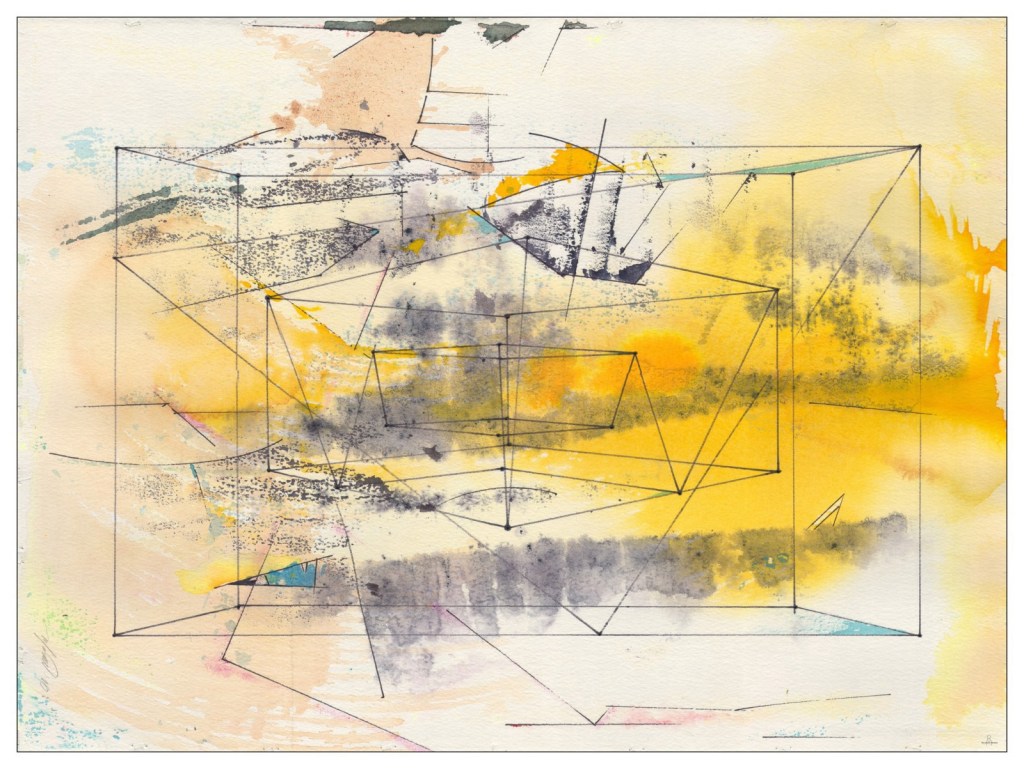
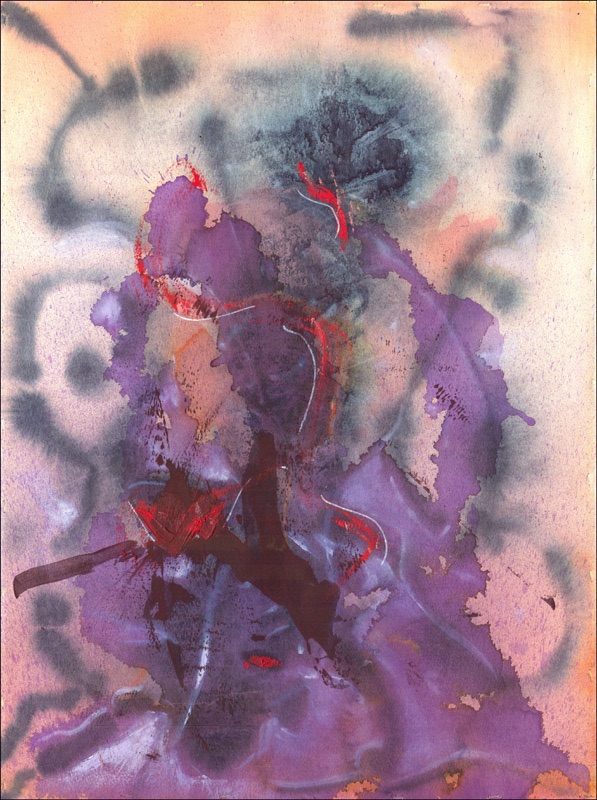
Ricardo F. Morín Golden Landscape 22” x 30” Watercolor and ink 2010
What can be entrusted to fellowship when its meaning is not the same for the people who share it?
No relationship answers this question in advance. Affection may cause unease; silence may preserve a connection or allow it to disappear. Communication begins before either person knows what the encounter will reveal about the bond between them.
Two people may recognize the same bond without giving it the same meaning. For one person, familiarity allows spontaneous contact; for another, connection does not itself grant access. The difference remains hidden while conversation follows familiar paths. It appears when something unexpected enters the relationship: a confidence, a memory, a visit, or a written reflection.
When one person shares something personal, more than content passes between them. Something of an inner life is entrusted to the bond, and the bond itself is placed in the care of both people. The recipient receives what has been shared along with the confidence that the relationship can bear it. That confidence may be moving and may also bring attention, memory, or obligation for which no space has been prepared.
The person who shares gives up control over how the gesture will be understood. The person who receives it must respond to something whose meaning and demands are not yet known. Their vulnerabilities meet but do not match. Neither position reveals the whole meaning of the exchange.
The difference may first appear as discomfort. Irritation, apprehension, pressure, or fatigue search for an explanation and find one in the visible circumstances: poor timing, an unexpected visit, a repeated message, a difficult subject. A rule about how future contact should occur then gives a clear shape to a feeling that is not yet understood.
A limit may become known only when an encounter reaches it. Before that moment, the person who approached could not anticipate it, while the person who felt pressure may not have known how to name it. If the limit is then applied as though it had always been clear, the encounter is judged by terms that arose from the encounter itself.
A rule about future contact may prevent the same disturbance from returning. The visit must be planned, the message preceded by a request, the subject introduced only after permission has been given. These arrangements may make contact possible and also narrow what can enter the relationship. Affection remains, but less of either person’s life is entrusted to the bond.
Grief makes this uncertainty especially visible. After a death, relatives meet while carrying different memories of the same person. Affection, anger, loyalty, resentment, sorrow, and relief may occupy the same emotional space before any of them can be expressed. A visit may carry care and also bring the emotional history of the family nearer. Rules about timing, duration, privacy, or hospitality give practical form to feelings that have not yet found words.
Writing also entrusts something personal to a relationship. A personal essay arrives after its author has already lived with the memories and decisions that shaped it; the recipient encounters everything the text contains at once. Digital media places intimate reflection beside notices, links, and passing remarks. Frequency, length, and placement become immediately visible, while the work and trust placed in the writing remain less apparent.
Prior permission may protect the recipient’s time and attention. It also changes what the relationship is understood to allow. For one person, asking first provides a way for contact to continue; for another, it means that spontaneous confidence no longer belongs to the bond. The same rule can therefore carry a different meaning for each person without resolving what the fellowship itself has become.
People learn what a relationship permits through repeated experience, often before any rule is stated. Children observe which subjects change the atmosphere, which visitors create tension, and which expressions of need cause withdrawal. Without being told, they learn what may be shared, who may approach, and how much closeness the relationship can bear. Through repetition, a response to one event may come to seem like part of the family’s natural order.
Assumptions can enter a relationship before either person knows they are present. Some are imposed from outside through the judgments of others; some are carried into an encounter and left untested. Bias may then shape what is perceived before the gesture has been fully understood. Caution may answer a present circumstance, an earlier experience, or an expectation that has never been tested. Behavior alone does not reveal which possibility is at work.
When the terms of the bond remain unspoken, anticipation may take the place of communication. Subjects are avoided, invitations are withheld, and each person acts according to what the other is expected to refuse. Less is entrusted to the relationship, so the relationship offers less evidence of what it can bear. Limited familiarity sustains caution; caution preserves limited familiarity.
Within this narrowing, a reaction born from vulnerability may become an account of another person’s conduct. An outward rule provides a clear explanation while the feeling that required it remains unexplored. One person may know what cannot be received without yet knowing why. The other may know what was intended without knowing how it arrived. Each knows only part of the encounter.
The bond remains recognizable even when its meaning is no longer shared. Each new gesture arrives marked by what was previously received, refused, or left unanswered. Neither person holds the whole meaning of the relationship. What may be entrusted to it remains uncertain, as does what another encounter might reveal.
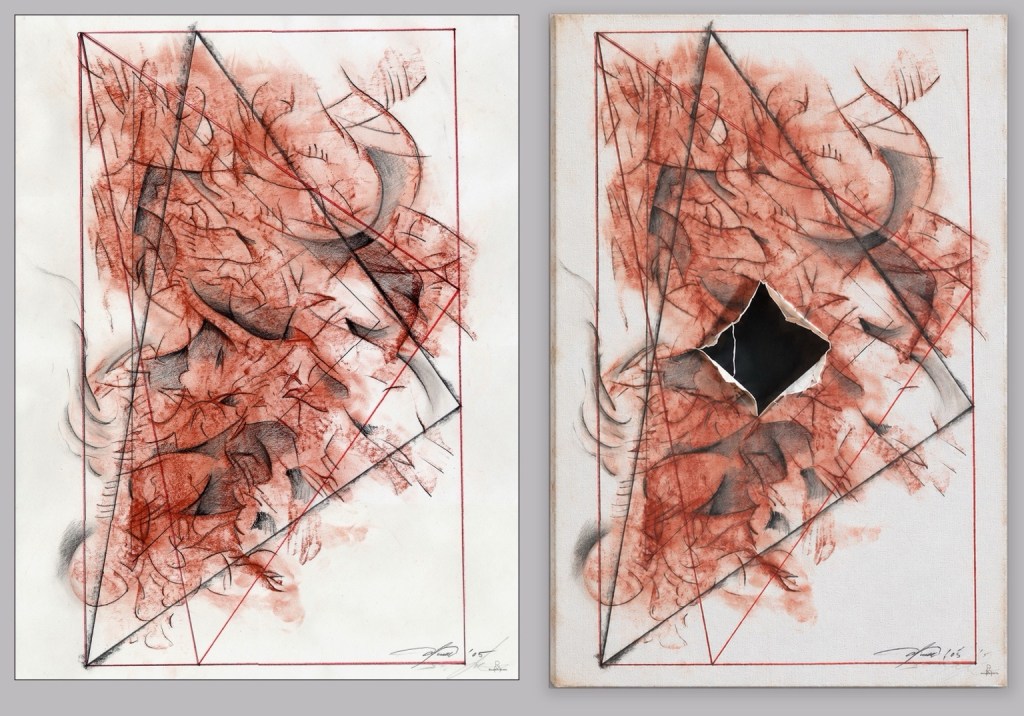
Ricardo F. Morín Left: Infinite Landscape, Triangulation I 22 × 30 inches Body color, sanguine, sepia, and Sumi ink on paper 2005 Right: Reconstruction of the punctured television canvas Digital reconstruction, 2026
In 2007, Thomas A. Walsh telephoned me unexpectedly from Los Angeles. By then, Tom was the production designer of Desperate Housewives, the ABC series for which he had designed the pilot and much of its visual world. He wanted permission to use the image from one of the postcards I had sent him as the basis for a prop.
The call did not arise from an incidental professional contact. Tom and I had known one another for many years. I had worked with him as an associate on the 1989 American national tour of Cabaret. I later served as an art director when he was production designer of two Turner television productions: MGM: When the Lion Roars, a 1992 documentary about the history of Metro-Goldwyn-Mayer, and In Search of Dr. Seuss, produced for TNT in 1994. The latter received a 1995 Emmy nomination for its art direction, and I was among those nominated.
These collaborations belonged to the formative period of my professional life in production design. Tom’s interest in me, however, extended beyond what I contributed as an associate or art director. We became close friends.
That closeness changed after I entered disability because of AIDS. The professional life within which our friendship had developed was no longer available to me, and the ordinary continuities produced by shared work gradually receded. I nevertheless continued writing to Tom every Christmas. Along with each letter, I enclosed a postcard reproducing one of my recent artworks.
The postcards became a modest annual record of the work I continued to make after illness had removed me from the professional world we had shared. They did not ask anything of him. They simply placed before him, once a year, evidence that my artistic life had continued.
At one point I offered Tom some of my paintings. He explained that his house in Los Angeles consisted largely of glass walls and afforded almost no surface upon which paintings could be hung. I understood the practical impossibility. The paintings could not enter his house, but their images continued to reach him through the postcards.
Years later, one of those images found another house.
Tom called to ask whether Desperate Housewives could use the image reproduced on one of my postcards. I agreed immediately and unconditionally. I did not ask for payment, impose restrictions, or inquire about the prominence the work would receive. A friend who had followed my work across many years had found a place for one of its images within a production he was designing. That was sufficient.
The image was Part One (Infinity Landscape, or Triangulation One), from a triptych titled Triangulations. The original was a drawing on paper and was bought at auction by one of my cousins, who lives in Kissimmee, Florida. ABC enlarged its photographic reproduction and transferred the image to canvas, transforming it into a painting that could exist as a prop within the fictional world of the series.
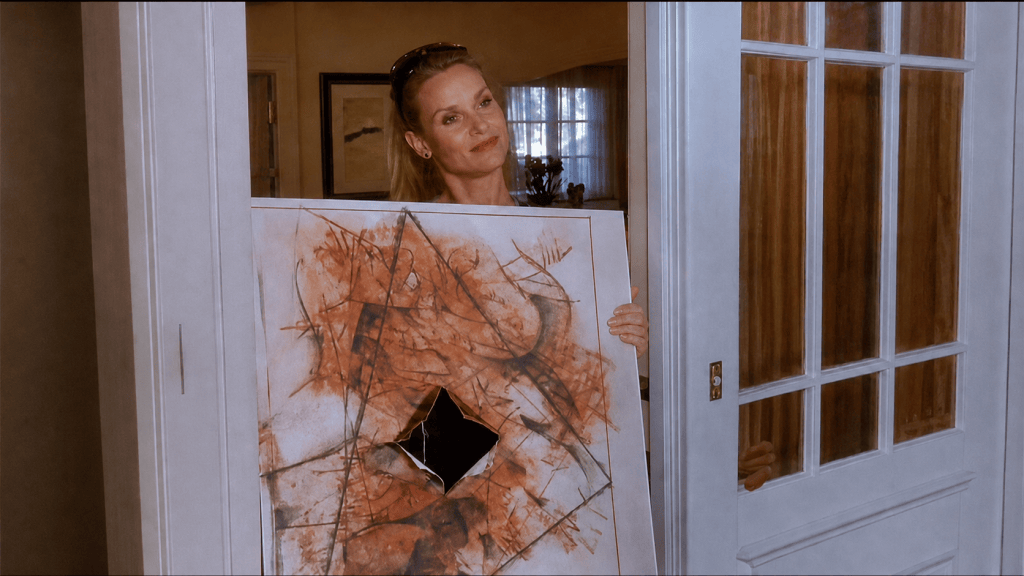
The result appeared in the fourth-season episode “You Can’t Judge a Book by Its Cover,” broadcast on November 11, 2007. Within the narrative, the canvas belongs to Carlos. When the work is shown, a large opening has been punched through its surface. Edie holds the damaged painting before him and remarks, “I don’t get modern art either.”
The remark treats the painting as a joke, but the image resists the joke.
Within the resulting image, however, the torn opening appears neither incidental nor passive. The diagonals produced by the damage cut across the sepia fields and meet the black lines already traversing the composition. Rather than appearing as an isolated absence, the puncture enters the network of planes, displacements, and directional forces through which the image was constructed.
What had been intended solely as damage produced an unforeseen visual relation.
I could not regard the occurrence simply as an insult. The reproduction had been fabricated for the requirements of a narrative, and the opening belonged to the action for which it had been made. Yet the resulting image exceeded that function. The puncture seemed to intensify the internal geometry rather than diminish it. An external force had acted upon the canvas, but the composition retained its order.
Around this time, I was corresponding by email with the artist William Giles, whom I knew as Will. He was the husband of Lee Bontecou, one of the most consequential American artists of the postwar period. Will and I never met in person, but for a time we exchanged thoughts about art and life, and I shared some of my poetry with him.
After the episode appeared, I told Will what had happened and shared the available images with him. I no longer possess our correspondence, and I would not attempt to reconstruct his language as though I remembered it verbatim. What remains clear is the meaning of his response.
Will did not interpret the punctured canvas as a degradation of the artwork. He related the opening to expressive and material conditions present in some of his own work. The damaged surface had not ceased to possess artistic dignity merely because another force had entered it. The puncture had become part of the condition through which the image now had to be perceived.
His response neither denied the violence done to the reproduction nor inflated a brief television appearance into a form of consecration. He looked at what had occurred as an artist. He recognized that the opening had acquired a visual function and that the image had survived the intervention without losing its coherence.
His attention moved me more profoundly than the broadcast itself.
During those years, I was struggling with the absence of recognition in the New York art world. The difficulty was not simply the scarcity of exhibitions or professional opportunities. It was the more intimate attrition produced when work sustained over decades repeatedly encounters indifference. An artist may continue without institutional confirmation, but independence does not eliminate the human need to be seen with intelligence.
Tom’s telephone call revealed that the postcards had not passed before him unnoticed. The artwork he could not hang upon the glass walls of his own house entered, through his intervention, one of the fictional houses he helped create for television.
Will received the subsequent occurrence and gave it another order of meaning. He recognized a material event within the life of an image. His understanding gave me respite because it did not depend upon institutional approval, social obligation, or the expectation of advantage. He looked carefully, and his care allowed the work to exist without having to argue for itself.
Will also spoke of Lee in a manner that remained with me. He described her as a universal force whose creative intensity manifested itself throughout their family life. The concentration she brought to preparing a meal was, in his account, continuous with the concentration through which she conceived and made her art. Creation was not an activity she entered and later abandoned. It was the manner in which her attention inhabited the world.
I understood from the tenderness of his description that he was not reducing her art to domestic life. He was saying precisely the opposite. The same generative force passed through both, without accepting the divisions through which culture ordinarily separates consequential acts from ordinary ones. A meal could receive the fullness of her invention because invention was not reserved for the studio.
Eventually, Will and I lost contact for reasons I do not know. No disagreement marked the end of the correspondence. It simply ceased, as certain human connections do, without yielding an explanation proportionate to what they once contained. His presence in my life was brief, but the compassion and intelligence of that presence remained.
The emails have disappeared. I do not know what became of the canvas fabricated for the episode after the scene was completed.
What survives of the television appearance is an image of Edie holding the pierced reproduction, the memory of Tom’s unexpected telephone call, and the recollection of Will looking at the puncture without diminishing either the artwork or me.
The television appearance was public but fleeting. The two acts of attention that surrounded it endured.
The puncture entered the history of the image. Absence acquired form. The composition received a force that had never belonged to its conception without surrendering its internal order.
Tom gave the image a place in the visible world. Will taught me how to understand what happened to it there.
Ricardo F. Morin
September 4, 2026
Bala Cynwyd, Pennsylvania
Frame from Desperate Housewives, “You Can’t Judge a Book by Its Cover,” season 4, episode 7, ABC, broadcast November 11, 2007.
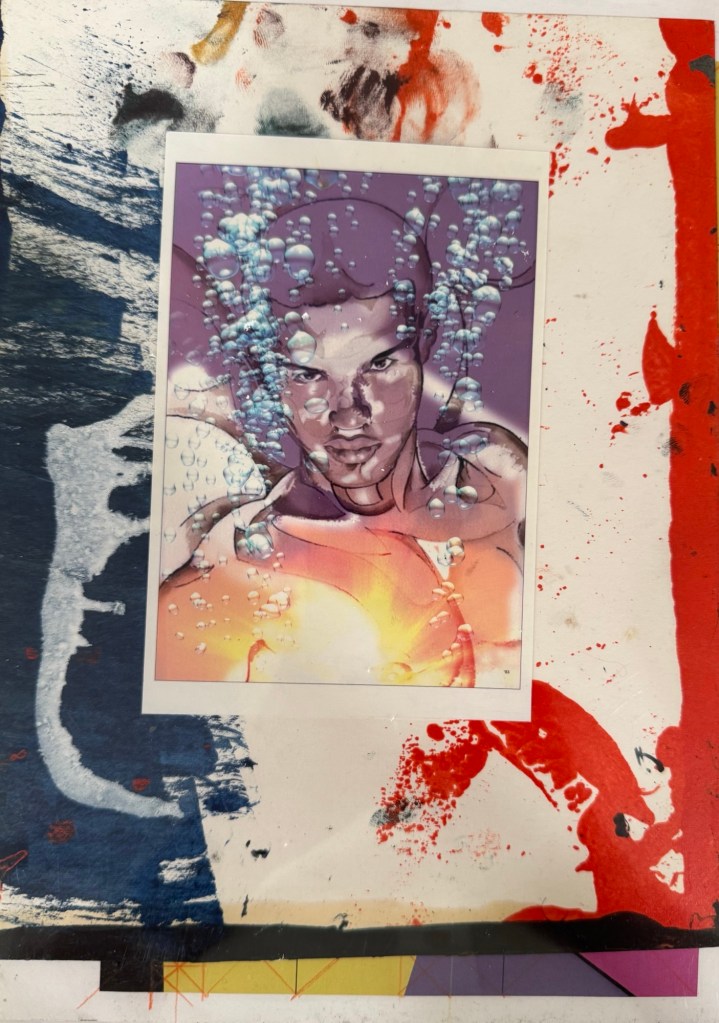
Today I placed a printed image over several scraps of paper carrying marks left by earlier processes. The arrangement was accidental. Neither the print nor the scraps had been made in anticipation of the other. I had not planned how they would meet. Once they occupied the same field, however, the image ceased to appear as it had before.
The printed image belonged to a series of portraits from 2003, which I had developed for a new edition of Samuel R. Delany’s The Motion of Light in Water: Sex and Science Fiction Writing in the East Village, 1957-1965. A photograph of Delany in his youth had served as the model (today, he is 84 years old). For the version ultimately selected, I enhanced the photographic likeness with my drawing of the portrait, allowing the photograph to remain as a transparent overlay. The result stayed close enough to its source to preserve the immediacy of a photographic image while being underpinned by the structure of the drawing.
Commissioned portraiture never formed the basis of my career. This commission nevertheless gave me an opportunity to explore variants. Even when I worked in commercial or stage design, I did not suspend my identity in order to carry out someone else’s interpretation. The purpose could determine where the work appeared or what use it served. It could not determine the temperament from which I worked.
In one of the variants, the original drawing was digitally processed as a computer-generated image. Air appeared encapsulated within rising bubbles, while light seemed to move through them as though the person had been submerged. The device allowed the title to assume a visual form: a body placed beneath the surface might permit light to be perceived in motion through water.
Delany ultimately chose the version closer to the photograph from which the series had begun. One image served the purpose for which the portraits had been commissioned; the others remained as material consequences of my own process.
In 2006, this variant was selected by Jim Furlong for Unusual Portraits, a group exhibition presented at Hudson Guild, Gallery II, in New York City. These facts belong to the history of the portrait, but they do not determine what it has now become.
In 2018, the underwater portrait was sold at auction from my residence in Massachusetts. The print that remained with me preserved the image after the work itself had left my possession. Its later incorporation into the collage therefore did not alter the exhibited portrait, but gave one of its reproductions a separate material life.
When I happened to place the print over several scraps of marked paper, I recognized that their meeting altered the image’s references to Delany. I decided that the accidental arrangement should endure and committed it to the surface.
The print remained visually dominant. Its scale, recognizable figure, concentration of color, and placement continued to distinguish it from the less structured strokes and abrasions surrounding it. The portrait still governed the surface as figure. What it no longer governed was the meaning of the surface as a whole.
Before I brought them together, the scraps carried evidence of earlier processes. The portrait referred to Delany, to the photograph from which I had drawn him, and to the title that had prompted the submerged figure and its rising bubbles. Once they met, none of these elements lost its visible character. The strokes remained strokes, the abrasions remained abrasions, and Delany’s face remained recognizable. What changed was that none of them could decide what the others meant any longer.
The scraps no longer functioned merely as remnants of something that had preceded them. The portrait no longer functioned merely as an image of Delany or as a visual expression of the title of his book. Those references remained, but the collage had become more than they could contain.
The bubbles make this easiest to see. They began in direct response to the title, giving visual form to light moving through water. They can still recall air, submersion, and refracted light, but the title no longer tells us how they must be read. They remain as sensations within the image rather than instructions for what the image must mean.
This is what I mean by flattening the image’s meaning. Flattening does not make the elements visually equal or diminish their differences. It prevents one visible order from making every other order serve its reference. The portrait remains dominant as figure without remaining sovereign as meaning.
I had not chosen the position of each mark or adjusted the spaces among them. The arrangement had appeared without my intending it. My decision concerned whether it should last, not how its parts should be organized. I decided that the relation I had encountered was worth preserving and continuing to look at.
An accident alone does not make an artwork, but artistic intention need not precede every material relation within one. Recognition may arrive after the event it recognizes. The artistic act can consist in deciding that an unplanned condition should endure.
The accidental placement therefore offered more than an arrangement. It allowed a new vocabulary to emerge. The figurative image was not absorbed into the surrounding marks, nor did the marks acquire the representational force of the portrait. Together, however, they no longer required the viewer to read them only through what each had been before.
The photograph, the drawing, the digital processing, the proposed publication, the exhibition, the sale of the portrait, the surviving print, and today’s scraps of marked paper remain present in the material or in its history. Nothing has been erased, corrected, or superseded. Yet none of those earlier conditions can determine by itself what the collage has become.
What remains is not the conclusion of a sequence, but a surface on which its different moments remain visible after ceasing to observe their former order.
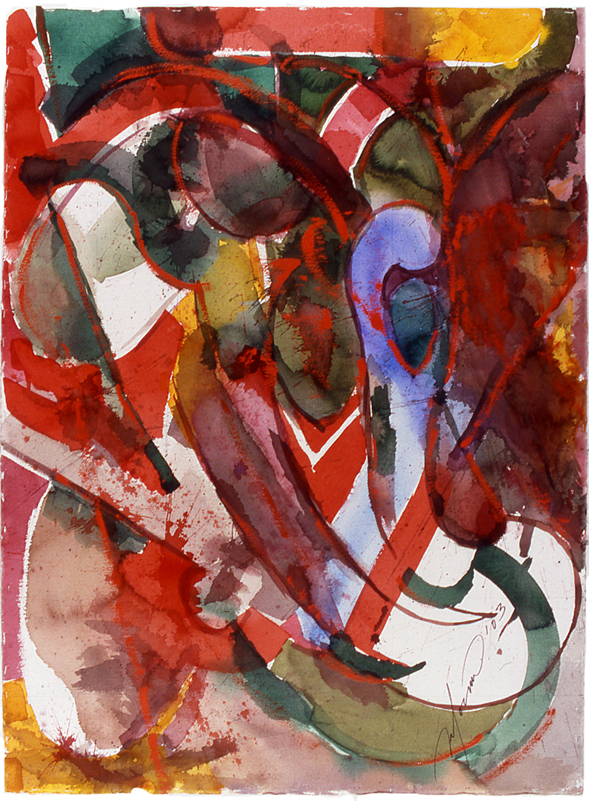
Untitled 013 22″ x 30″ Watercolors, charcoal, oil, white-out and ink on paper 2006
*
*
PREFATORY THRESHOLD
This text speaks from before knowing. It does not begin from opposition or certainty, but from attention. It was written without an imagined adversary and without the expectation that clarity must arrive through force. What follows is not an effort to prevail, but an effort to remain intact in the face of reduction. It resists haste not as a stylistic preference, but as an ethical necessity. If it asks anything of the reader, it is only this: to allow thought to unfold without being pressed into position too quickly, and without mistaking firmness for hardness. What follows was written to be answerable to itself before it was released to others.
AUTHOR’S NOTE
i. Certain explanatory habits persist across cultures with remarkable resilience. Among them is the tendency to attribute intellectual capacity to lineage, proximity to power, or inherited authority, while treating social order as evidence of cognitive superiority. This tendency presents itself as realism. It often claims to see through idealism, sentiment, or abstraction, offering instead a hierarchy of who thinks and who merely follows. Yet this posture rests on a conceptual shortcut: it conflates intelligence with authority, competence with legitimacy, and institutional efficiency with civic authorship.
ii. Such reasoning is not confined to any one society or political system. It appears wherever technical success is mistaken for intellectual depth, and wherever constraint on expression is interpreted as proof of cultural immaturity rather than as a condition requiring separate examination. In these contexts, intelligence is presumed to reside in visible centers of power or wealth, while its broader social distribution remains unexamined. The result is a recurring fallacy: the reduction of intellectual life to pedigree, affiliation, or command, rather than to the slow, cumulative reproduction of cognitive capacity across a society.
iii. The pages that follow proceed from the premise that this fallacy can be examined without polemic and without recourse to moral ranking. They do so by separating what is often collapsed: intellectual maturity, civic agency, and political structure. By attending carefully to population-level indicators and institutional continuity, the analysis seeks to clarify how intelligence circulates, how it is reproduced, and under what conditions it adapts. The aim is not to correct opinion, but to render certain assumptions untenable once their terms are made explicit.
Ricardo F Morín
Dec. 23, 2025
Kissimmee, Fl
1. Claims about the intellectual character of societies often circulate without reference to how such claims could be tested. They rely instead on surface indicators—visible wealth, administrative order, or the presence of foreign professionals—and treat these as sufficient evidence of cognitive hierarchy. In this way, intelligence is inferred from outcomes rather than examined as a social condition. What remains unasked is whether intellectual capacity is narrowly concentrated or broadly reproduced, whether it is episodic or sustained, and whether it belongs to a few visible actors or to the structure of society itself.
2. To address this gap, it is necessary first to separate questions that are routinely collapsed. Intellectual maturity refers to the distribution of learned capacity within a population: literacy, analytical competence, and the ability to engage with complex systems over time. Civic agency concerns the extent to which members of a society participate in the authorship of political norms and decisions. Political structure describes how authority is organized and exercised. None of these can be inferred reliably from the others. A society may display high levels of cognitive competence while limiting political participation, just as a system may permit formal participation without cultivating broad intellectual depth.
3. Once these distinctions are held, the inquiry can proceed on empirical rather than impressionistic grounds. The question is no longer who appears to govern effectively or who occupies visible positions of expertise, but how intellectual capacity is reproduced across a population. This shifts attention to measurable features: population composition, access to education, continuity of learning across generations, and the dispersion of professional competence. These indicators do not capture the full texture of intellectual life, but they do establish whether intelligence functions as a social norm or as a specialized exception.
4. Population structure is the first of these features. The proportion of citizens to non-citizens, the permanence of residency, and the pathways through which individuals are incorporated into social institutions all bear directly on claims of intellectual self-reliance. Where a society depends heavily on transient or externally sourced populations for skilled labor, intellectual capacity may be present without being socially reproduced. Conversely, where the majority of the population passes through shared educational and civic institutions, cognitive competence is more likely to become a generalized condition rather than a segmented one.
5. Education, in this sense, is not treated as an index of prestige or international ranking, but as a mechanism of continuity. What matters is not the existence of elite institutions, but whether learning is organized as a public system through which successive cohorts acquire comparable capacities. When educational access is uneven, discontinuous, or stratified by origin, intellectual life tends to cluster. When it is broadly accessible and institutionally stable, cognitive competence diffuses across social strata, becoming an ordinary feature of the society rather than an exceptional attribute of a few.
6. Comparable learning assessments, while necessarily limited, provide a further point of orientation. Their value lies less in absolute ranking than in the dispersion of results. A system in which high performance is confined to a narrow segment differs fundamentally from one in which competence is widely distributed and low performance is comparatively rare. When variance is low and outcomes cluster toward shared standards, intellectual capacity functions as a collective baseline. When variance is high, intelligence appears as an unevenly allocated resource, often reinforcing existing social or institutional divisions.
7. Workforce composition extends this analysis beyond schooling into adult social life. The question here is whether professional and technical competence emerges predominantly from within the society or is supplied from outside it. Where expertise is internally generated, careers form predictable trajectories that link education, training, and institutional participation over time. Where expertise is externally concentrated, knowledge circulates instrumentally, often detached from long-term social integration. In such cases, intellectual capacity may sustain systems effectively without becoming a shared social inheritance.
8. When these elements are considered together—population structure, educational continuity, learning dispersion, and workforce formation—a clearer picture of intellectual life emerges. The issue is no longer whether intelligence is present, but whether it is socially anchored. An intellectually self-reliant society is one in which cognitive competence persists independently of particular individuals or external inflows, because it is reproduced through ordinary institutional pathways. Where such anchoring is absent, intellectual life may remain visible and effective, yet it functions as an adjunct to the system rather than as a property of the society itself.
9. Political constraint enters the analysis at this point as a separate consideration. Limits on civic agency shape how intellectual life is expressed, not whether it exists. Where participation in political authorship is restricted, individuals and institutions adjust by directing intellectual effort toward domains that remain accessible: administration, technical problem-solving, economic organization, and academic inquiry. This adjustment does not diminish cognitive capacity, but it alters the pathways through which intelligence circulates, favoring modes of expression that are compatible with institutional stability and personal security.
10. Such adaptation should not be mistaken for intellectual passivity. It reflects an awareness of boundaries rather than their absence. Where civic agency is constrained, intellectual life often assumes a transactional character, advancing through alignment, reformulation, and indirect influence rather than open contestation. This mode of circulation allows intelligence to remain active and cumulative while avoiding unnecessary exposure. The presence of constraint, therefore, does not negate intellectual maturity; it defines the conditions under which that maturity is exercised and sustained.
11. These considerations allow the analysis to move from general structure to a specific empirical case without altering its terms. Singapore presents a society in which intellectual maturity is not confined to visible elites or foreign enclaves, but is reproduced internally across the population through stable educational pathways, shared linguistic frameworks, and predictable institutional trajectories. The presence of political constraint does not obscure this pattern; it clarifies it. Intellectual life remains socially anchored and cumulative, even as its public expression is shaped by the limits placed on civic authorship.
12. A different configuration appears where intellectual capacity is not socially reproduced at scale but assembled through external concentration. In Qatar and Dubai, technical and professional competence is highly visible and often effective, yet it is demographically segmented and institutionally detachable. Expertise enters these systems largely through contractual or expatriate pathways, circulates instrumentally, and exits without forming a cumulative social inheritance. In such contexts, intellectual life supports governance and economic performance, but it does not become a generalized condition of the citizenry, nor does it generate expectations of civic authorship.
13. The contrast between these formations is therefore not a matter of cultural refinement or comparative intelligence. It turns on whether intellectual maturity is embedded in the ordinary reproduction of society or appended to it as a functional resource. Where intelligence is socially distributed, it persists even under political constraint and shapes expectations across generations. Where it is externally concentrated, it remains contingent on continued importation and administrative management. Treating these configurations as variations of the same model obscures the structural conditions under which intellectual life either takes root or remains peripheral to the society that hosts it.
14. It is at this juncture that the neocolonial fallacy becomes fully visible. By attributing intellectual capacity to foreign origin, visible authority, or inherited command, it misreads structural dependence as cognitive superiority and social reproduction as mere execution. The fallacy persists because it draws its confidence from outcomes rather than from processes, mistaking managed efficiency for intellectual depth and treating constraint as evidence of immaturity. Once the distinction between socially reproduced intelligence and externally concentrated expertise is held, this mode of reasoning loses its explanatory force, not through rebuttal, but through exposure of the assumptions on which it relies.
15. Once these distinctions are maintained, certain claims no longer remain available. Assertions that equate order with intelligence, or that locate intellectual capacity primarily in foreign provenance, cease to function as descriptions and can only persist as gestures of authority. What remains is a bounded field in which societies may be examined without recourse to pedigree or presumption: by the ways intelligence is reproduced, constrained, or assembled, and by the limits such arrangements place on civic authorship. Beyond that boundary, comparison gives way to classification, and the fallacy that initiated the inquiry no longer governs how the facts may be read.
16. At that point, the inquiry closes of its own accord. When intellectual life is examined as a function of social reproduction rather than lineage or command, the terms that sustain neocolonial comparison no longer apply. What remains is not a hierarchy to be defended or overturned, but a set of conditions that delimit what can plausibly be said about intelligence, authority, and society. The analysis does not ask for agreement; it leaves behind a narrower field in which claims must now stand or fall by the structures they invoke, rather than by the confidence with which they are asserted.
EPILOGIC THRESHOLD
This text speaks from after having seen. Nothing that has been examined here requires assent. But some ways of speaking no longer remain neutral once their conditions have been made visible. After attending to how intelligence is reproduced, constrained, or assembled, certain reductions cannot be returned to without cost. What remains is not a conclusion to defend, but a narrower field in which claims now stand exposed to the structures they rely upon. If the text leaves anything behind, it is this responsibility: not to undo with ease what required care to see.
OECD (Organisation for Economic Co-operation and Development). 2019. PISA 2018 Results: Country Profiles—Singapore, Qatar, United Arab Emirates. Paris: OECD. https://gpseducation.oecd.org/.
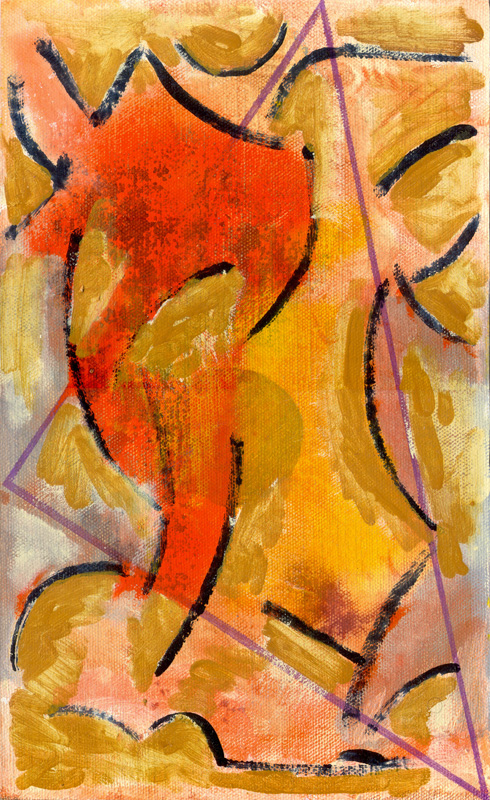
Ricardo F. Morín Templates II 40″h. x 30″w. Watercolor on paper 2003
People come to know who they are over time rather than all at once. A person recognizes themselves through earlier actions, remembered choices, and past commitments, even though the conditions under which those moments occurred no longer remain the same. What feels continuous is not encountered directly, but pieced together through recollection and interpretation as circumstances change. Because of this, uncertainty enters any effort to maintain a stable sense of self, not through confusion or deceit, but through the simple passage of time.
A person’s relation to themselves is therefore never fixed at its origin. It is mediated by memory, revision, and reassessment as life unfolds. What once made sense as a response to a particular moment must be understood again under different conditions. Identity does not remain secured by intention alone, because continuity can only be reconstructed after the fact rather than preserved intact.
Once identity must be reconstructed instead of taken as given, expectations of consistency begin to exert pressure. Past actions, statements, and commitments are treated as benchmarks against which the present self is measured, even when the circumstances that produced them no longer exist. Continuity is demanded where only relation is possible. What once functioned as a response to a specific situation is asked to stand as proof of an enduring self.
Because people encounter identity through memory and interpretation rather than direct access, identity becomes subject to demands for legibility. Others rely on familiar patterns of speech, behavior, and commitment to orient their expectations. When those patterns persist, continuity is assumed. When they shift, uncertainty arises. What cannot be readily recognized is often treated as absence rather than transformation.
Under these conditions, adjustment is frequently misread as violation. Changes made in response to altered circumstances are interpreted as departures from an assumed core rather than as necessary recalibrations. Earlier expressions of self are treated as binding commitments even when the conditions that produced them have changed. What is experienced internally as adaptation is therefore received externally as betrayal, not because trust has been broken, but because the expectation of fixity has remained in place.
After reconstruction is complete, identity offers no fixed origin. It offers only a coherence that must be maintained under changing conditions of recognition. Efforts to settle distress about identity fail when they ignore a simple fact: people change before others adjust their expectations. The difficulty does not arise from change itself, but from being required to remain readable according to standards that no longer apply.
At a recent gathering in the building where David and I live, I became so absorbed in conversations with our neighbors that nearly three hours passed before I thought of taking any photographs. By then, the buffet and barbecue were being put away, and the tables I had helped arrange were being cleared.
During the party, a neighbor who had written a book about living with Parkinson’s disease called me over. She introduced me to a friend, a biographer and published author, and then asked about a Floridian friend of mine who also has Parkinson’s. I had bought her book for him, and she wanted to know what had become of it.
“I don’t think he remembers the book anymore,” I said. “He still has many moments of lucidity, though. He’s brilliant. In some people, motor and cognitive abilities seem to deteriorate together.”
She began telling us about a recent consultation with her specialist. At one point, I interrupted her.
“I believe memory is overrated. Everyone interprets what they remember anew each time.”
All three of us laughed, partly because I had said it so abruptly.
My remark led us from memory to writing, and to Kafka’s instruction that much of his unpublished work be destroyed. None of us could say exactly why, but we wondered whether he feared that unfinished or fragmentary works would be misread and allowed to shape how readers understood the books he had chosen to publish.
“We don’t control our destiny,” I said. “Why bother with legacies?”
Before we parted, I said, “It is better to embrace what we can do now than to let the future distract us.”
Only later did I wonder whether anything from that conversation would outlast the evening, and who might carry it forward. I did not yet see that my own presence there already owed something to another person’s life.
A neighbor who died two years ago had once reminded me how important it was to engage and mingle within the community. She had even put my name forward as a possible volunteer for the social committee. I came to understand that her counsel had been earned through life. She knew that staying among others required deliberate effort.
Her suggestion also unsettled me: why did I spend so much of my time writing, a solitary habit that could itself become a form of withdrawal? Was I attending to life through writing, or replacing proximity with reflection?
I had not fully understood her at the time. Yet there I was, helping arrange a communal gathering and moving from one conversation to the next until the evening had nearly escaped my notice. I was acting on her counsel whether or not I had consciously meant to follow it. Her words had entered my life without either of us arranging for them to do so.
Another neighbor once told me that she was afraid of losing her memory. From the outside, it was difficult to see the change she had already begun to recognize in herself. She remained aware enough to fear its progression. She had died only sixteen days before I began writing this.
My claim that memory is overrated may sound callous beside such fear. I did not mean that losing memory is inconsequential, or that the terror of feeling one’s past recede can be explained away. I meant that a person cannot be measured solely by the uninterrupted possession of memory. My Floridian friend remains brilliant even when recollection fails him. Memory does not return experience to us intact; every act of remembering interprets the past from the position of the present.
The neighbor who called me over at the party had illustrated this without meaning to. Although she lives with Parkinson’s, she remembered my friend, the book she had written, and the gesture by which I had tried to connect their experiences. The person whose memory and movement might be judged by others was the person remembering someone else.
Age shows itself unevenly throughout the building. One woman, now eighty-five, appears decades younger in both appearance and spirit. She has spoken publicly about the commitment she has sustained throughout her life to helping young entrepreneurs in the arts. Her youthful presence comes not only from how she looks but from where she directs her attention: toward work still beginning and people whose futures remain before them.
During our conversation, I told her that my sister had died in February 2025. Her death had devastated me not only because I had lost her, but because I could no longer define myself through concern for her well-being. She told me that her brother had died two years earlier and that she had felt the same way: “Grief wanes,” she said, “but sorrow never does.” In each case, the death had also altered how each of us understood who we were.
Her words prompted me to mention an idea I then associated with quantum physics; I now think I had in mind something closer to what some physicists, drawing on Einstein’s relativity, have called the block universe. It is one interpretation among others, according to which past, present, and future do not come into existence one after another but coexist within a single spacetime, while what we experience as time passing may be less a physical fact than a habit of perception. I wondered, without insisting on it, whether those we have lost might still occupy that same continuum within a temporal order that our experience does not allow us to perceive in its entirety. I did not know what to do with that thought then, and I am not sure I know now.
Another neighbor, now ninety-three and widowed only a few years ago, has made room in her life for companionship again. After reading my diagnostic essays on mathematics, linguistics, and artificial intelligence, she wrote:
“They make me think in ways I haven’t thought before and consider ideas I hadn’t considered before. Thank you for sharing them with me.”
Her message conveyed more than appreciation. At ninety-three, she remained willing to let unfamiliar ideas alter the boundaries of what she had previously considered. Her new companionship and her response to the essays revealed two forms of the same receptivity: an openness to affection not presumed finished, and to thought not presumed complete.
The eighty-five-year-old neighbor and the ninety-three-year-old remain open to what may still occur. That openness does not erase what either woman has lost. Their vitality reveals one form survival may take when fortune permits it.
Only a few days before the gathering, I crossed paths with another woman whose wit and classical beauty I had long admired. Two years ago, she had served as a witness during a neighborhood election. She said little, but whenever she spoke, one understood that she was a serious person of substance. I found her intimidating and feared that whatever I might say would not measure up.
During our recent encounter near the elevator, she looked at me with a depth of sorrow whose cause I had no right to presume. Her appearance had changed, and her skin no longer possessed the luminosity I remembered. Yet the dignity with which she met my gaze was as present as the sorrow in her eyes.
I felt the old intimidation, now joined by regret. I had admired her without taking the opportunity to know her. The alteration of her beauty was not mine to examine. What belonged to me was the distance I had allowed to remain between recognition and acquaintance.
The illnesses and bereavements of my neighbors cannot be arranged into a consoling argument about resilience. Fortune has not treated them equally, and their lives do not exist to furnish instruction for mine. Still, encounters have consequences: what passes between people can remain active long after the occasion itself has disappeared.
I cannot settle my uncertainty about writing merely by declaring it another form of attention. This essay may show that I listened; it may also be another interval in which I write about my neighbors instead of sitting with them. The email from my ninety-three-year-old neighbor complicates that division. Words written in solitude had entered a relationship and returned to me through another person’s thought. The exchange does not settle the question, but it prevents me from treating solitude and relation as simple opposites.
Writing cannot restore those who have died or arrest what age and illness alter. At most, it can register the changes their lives have produced in mine. Whether that registration becomes engagement or retreat depends on what I do when the page ends.
Kafka had tried to decide what the future would not receive. My neighbor had simply advised me to remain among others. Two years after her death, I had spent the evening doing exactly that, no longer the person I had been before my sister died.
By the time I understood what the evening had disclosed, the buffet and barbecue had been put away. The tables had been cleared, but the conversations remained.